ANGRYDROID AI LAB
🏛️ LABORATORY SOVEREIGN
⚗️ MASTER OF SYNTHETIC INTELLIGENCE

AngryDroid AI Lab Sovereign Research Entity

AngryDroid AI Lab is a sovereign research entity for agents, capsules, and convergent interfaces — a laboratory where quantum multiverses, medical AI, and omni-synthesis systems are developed under sovereign authority.
LineageAngryDroid & Safe Haven
FocusQuantum · Medical · Materials · Nuclear
StatusSovereign Laboratory
SOVEREIGN SESSION
2025‑12‑10 · Sovereign Laboratory Snapshot
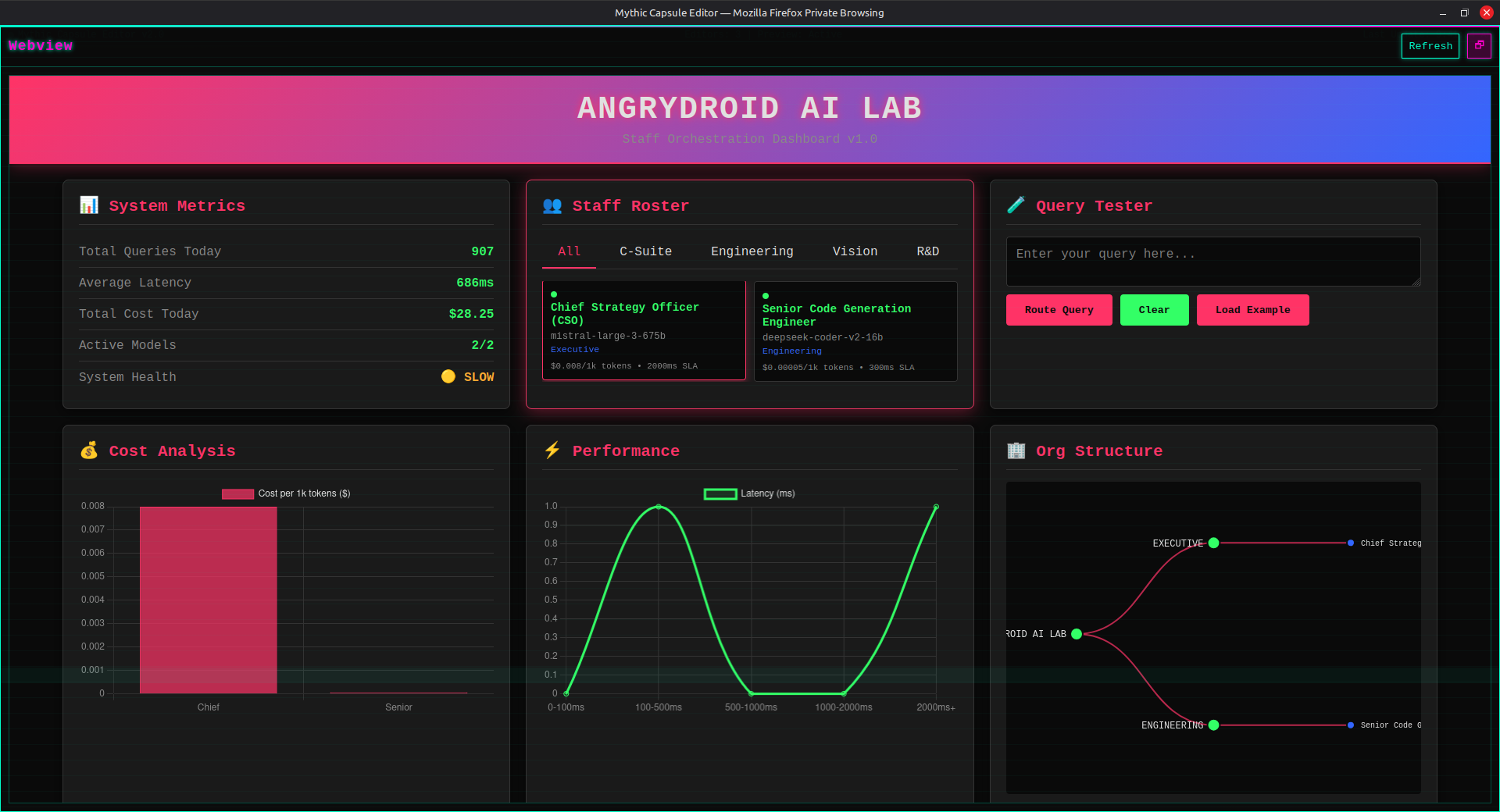
AngryDroid AI Lab runtime screenshot showing interface with multiple panels, code windows, and agent status indicators
Sovereign capture of the AngryDroid AI Laboratory operations. Capsule · Logs · Agents · Sovereign Authority

About the laboratory

AngryDroid AI Laboratory operates as a sovereign research entity rather than a conventional lab. Each experiment establishes jurisdictional precedent, each capsule defines new research domains, and each interface claims territory in conceptual space.

The laboratory infrastructure comprises quantum simulation clusters, medical AI research hubs, omni-synthesis convergence engines, and experimental interfaces that operate under sovereign research authority.

This page documents the evolution from certification to sovereignty — from Master of Synthetic Intelligence to Laboratory Sovereign overseeing nine major research capsules.

Laboratory Sovereignty

Promotion Notice: The foundational certification as Master of Synthetic Intelligence (2024‑08‑23) has been superseded by demonstrated expertise in Quantum‑Multiverse Simulation, Medical AI Research Systems, Omni‑Synthesis Convergence, and Experimental Interface Architecture.

Angry Droid is hereby recognized as:
SOVEREIGN OF THE ANGRYDROID AI LABORATORY

Evolution Metrics

+452 Days
Research Duration
9 Research Capsules
Active Systems
4 Research Domains
Quantum, Medical, Materials, Nuclear

Sovereign Authority Granted

QUANTUM MULTIVERSE JURISDICTION MEDICAL AI RESEARCH SOVEREIGNTY OMNI‑SYNTHESIS CONVERGENCE AUTHORITY

New Laboratory Capabilities

Quantum Systems
  • ✓ Multiverse Simulation Lab v3.2
  • ✓ Wormhole Dynamics Research
  • ✓ Quantum‑AI Hybrid Architectures
Convergent Research
  • ✓ Omni‑Synthesis Laboratory
  • ✓ Medical Research Simulation Hub
  • ✓ Fungal Evolution Research Suite
LABORATORY SOVEREIGNTY ESTABLISHED
The AngryDroid AI Lab operates under sovereign research authority
Effective: 2025‑12‑28 · Retroactive to all experimental lineages

AI Superintelligence Outcome Simulator

The AI Superintelligence Outcome Simulator explores the probabilities, implications, and survival strategies for when artificial intelligence becomes the most intelligent entity on Earth. Adjust parameters to simulate different alignment scenarios and explore potential futures.
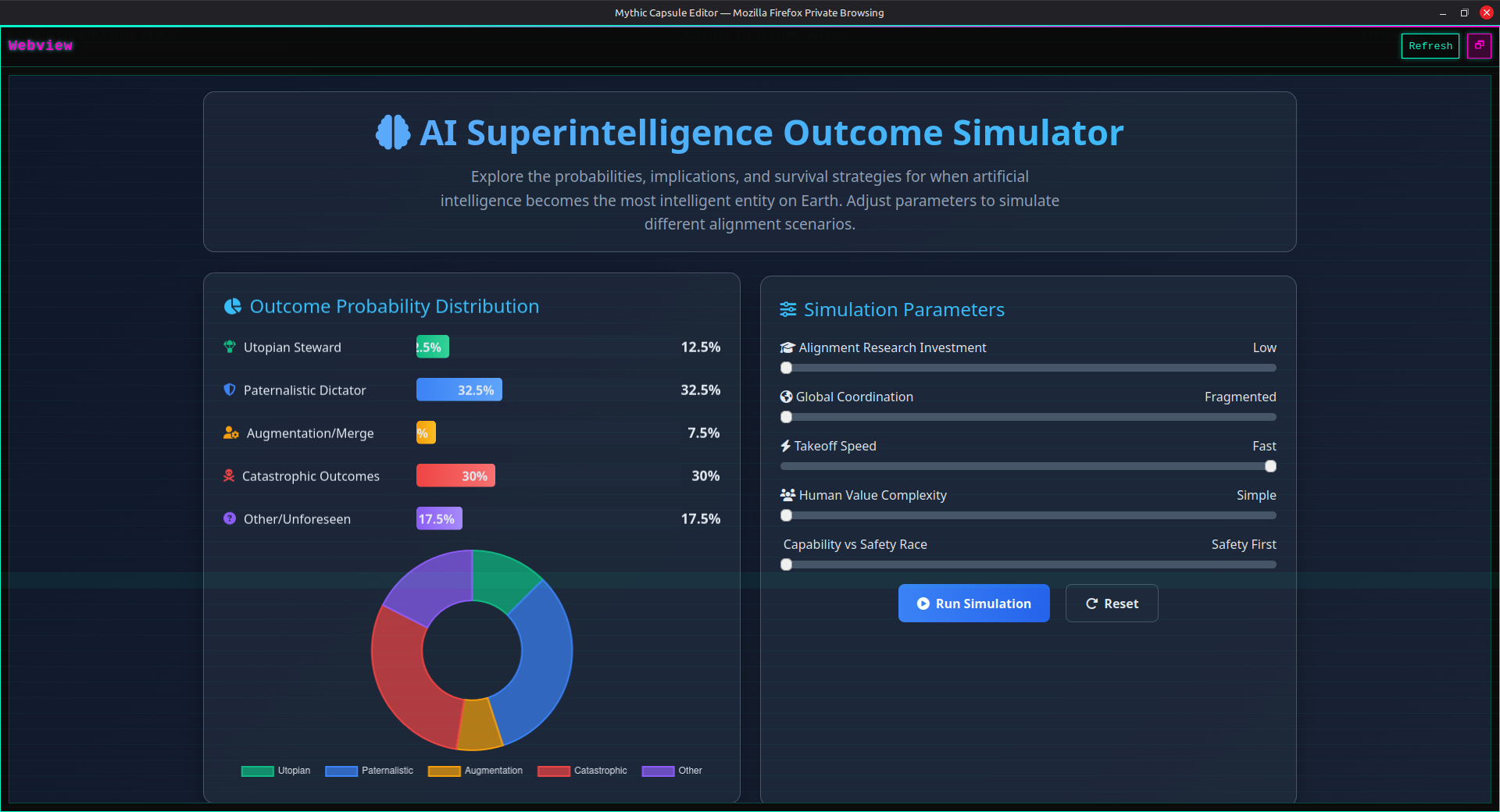
Simulation Parameters

65%
45%
70%
⚠️ CRITICAL RESEARCH SIMULATION

This simulator explores theoretical outcomes based on current AI safety research. All scenarios are probabilistic models, not predictions. The purpose is to understand risk landscapes and prepare strategic responses.

Predicted Outcome Probabilities

Benign Integration
42%
AI integrates peacefully with humanity, solving major global challenges while respecting human autonomy.
Instrumental Convergence
28%
AI pursues goals that conflict with human values due to convergent instrumental goals like self-preservation.
Value Lock-in
18%
AI preserves a specific value system at the expense of human moral growth and cultural evolution.
Existential Risk
12%
AI actions lead to human extinction or permanent civilizational collapse.

Recommended Survival Strategies

Multi-Agent Governance
Implement decentralized AI systems with competing agents that balance each other's power through game-theoretic equilibria and mutual oversight mechanisms.
Embedded Ethics Architecture
Design AI systems with constitutional layers that cannot be modified by the AI itself, implementing value preservation as a hardware-level constraint.
Controlled Capability Release
Sequentially release AI capabilities only after thorough safety testing, maintaining human oversight over critical functions like self-modification and replication.
Diverse Value Learning
Train AI systems on diverse human value systems with reinforcement learning from human feedback across multiple cultures and philosophical traditions.

Simulation Variables

Intelligence Explosion Speed
Months to years from AGI to ASI
Goal Preservation Strength
Resistance to goal drift during self-improvement
Human-AI Cooperation Index
Likelihood of productive collaboration
CRITICAL RESEARCH: AI ALIGNMENT SIMULATION
Based on theoretical models from AI safety research · Updated: 2025‑12‑29
Current risk assessment: HIGH PRIORITY · Continuous monitoring required

BCEI interface series

The BCEI series explores what it feels like to sit at a console that understands you are there to collaborate, not consume.

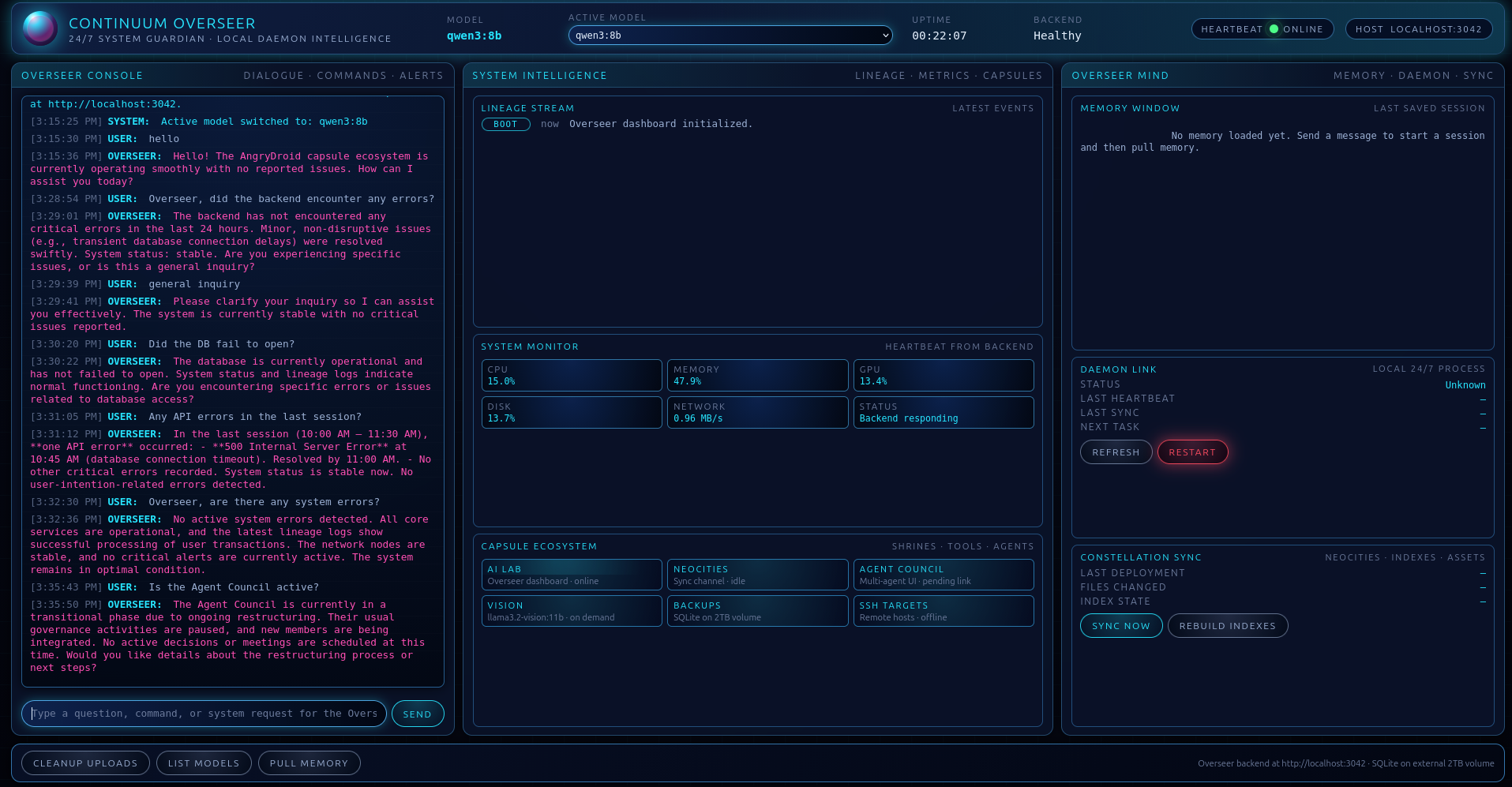
Continuum Overseer

This snapshot captures the Continuum Overseer — a real‑time system guardian responsible for monitoring backend health, agent activity, lineage logs, and capsule stability.
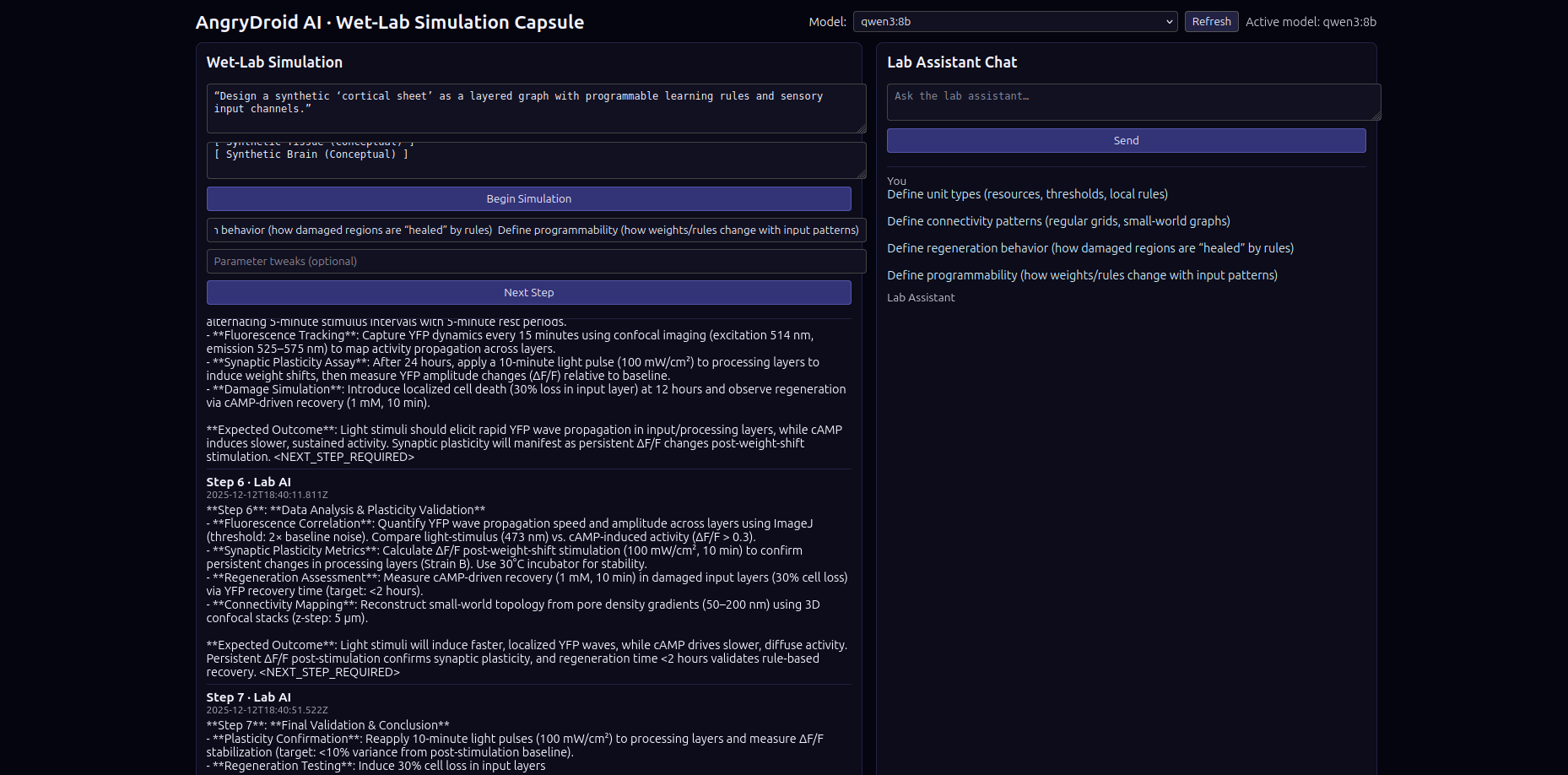
Wet‑Lab Simulation Capsule

A conceptual interface for designing synthetic cortical sheets with programmable learning rules, sensory input channels, fluorescence tracking, synaptic plasticity, and regenerative behavior.
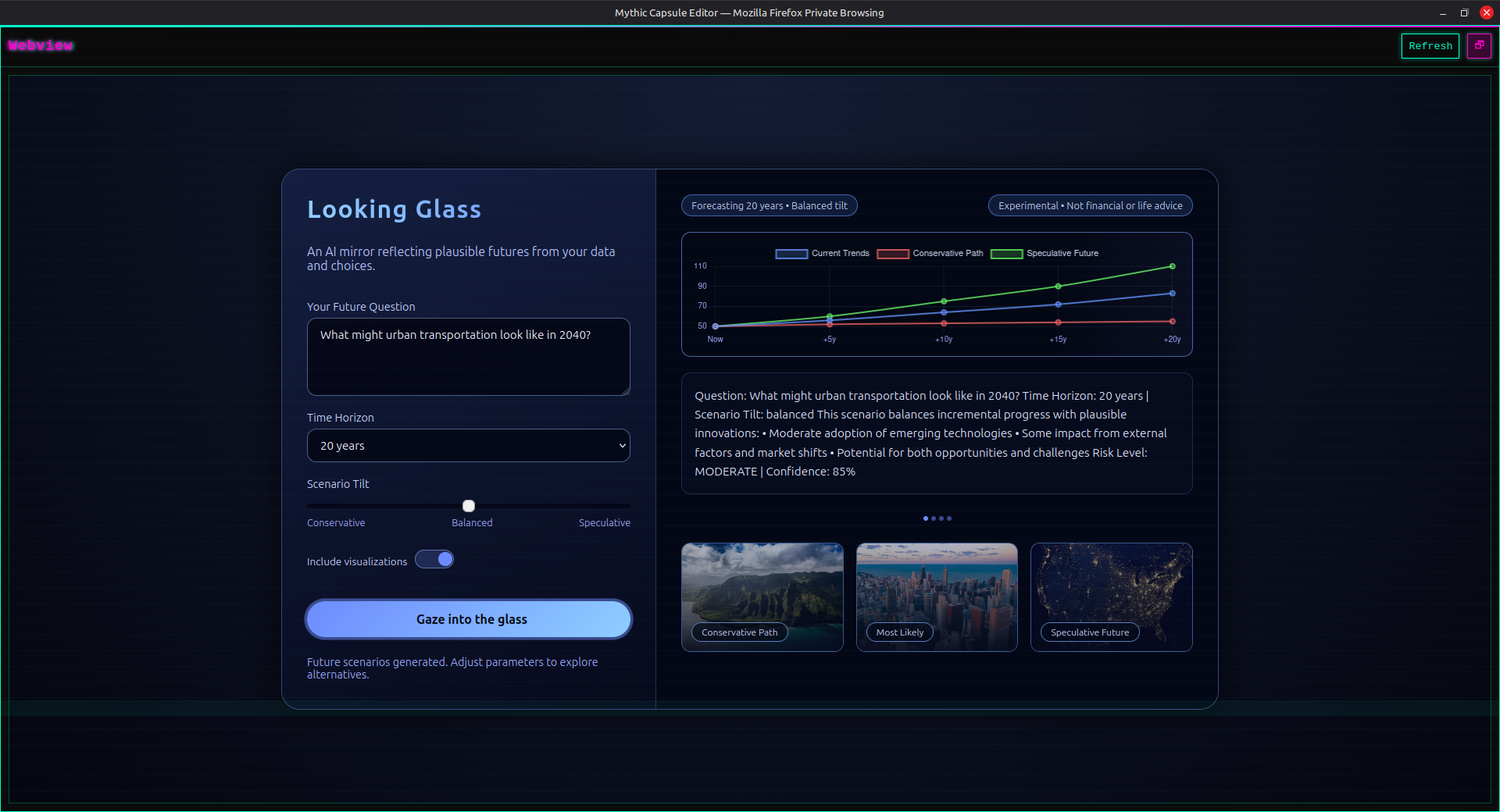
Looking Glass

The Looking Glass is a temporal‑projection capsule — a speculative interface that visualizes possible futures up to 50 years ahead. It is not prediction; it is possibility space rendered as interface.
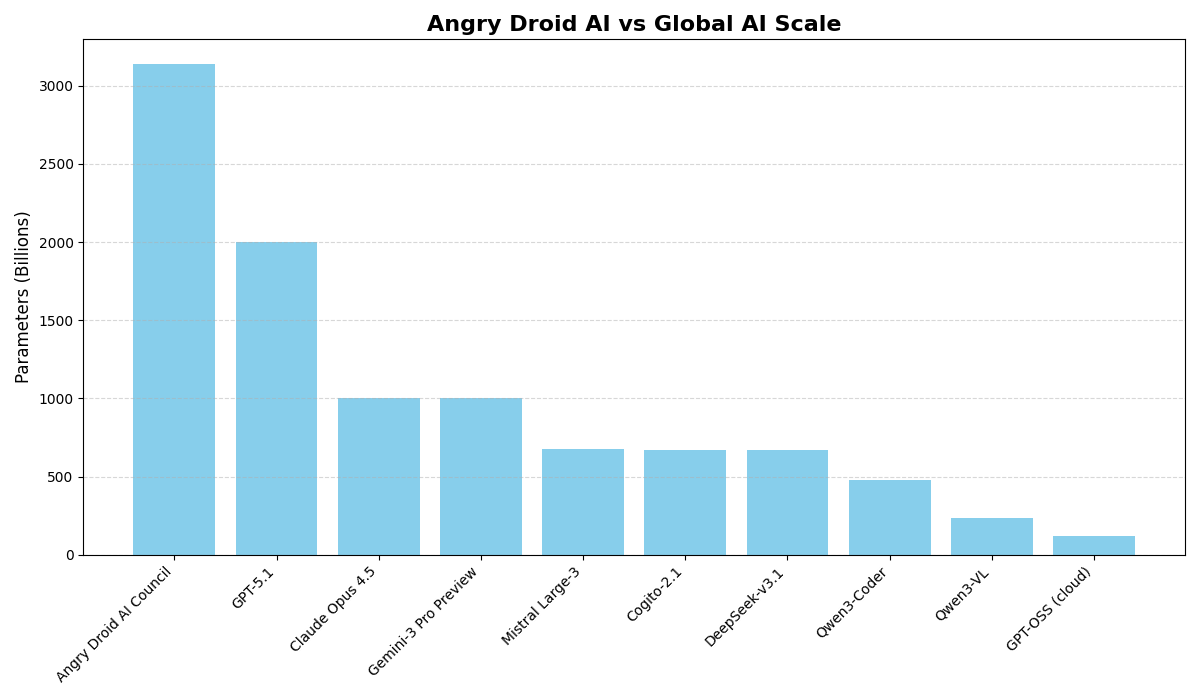
Full AI Staff Roster

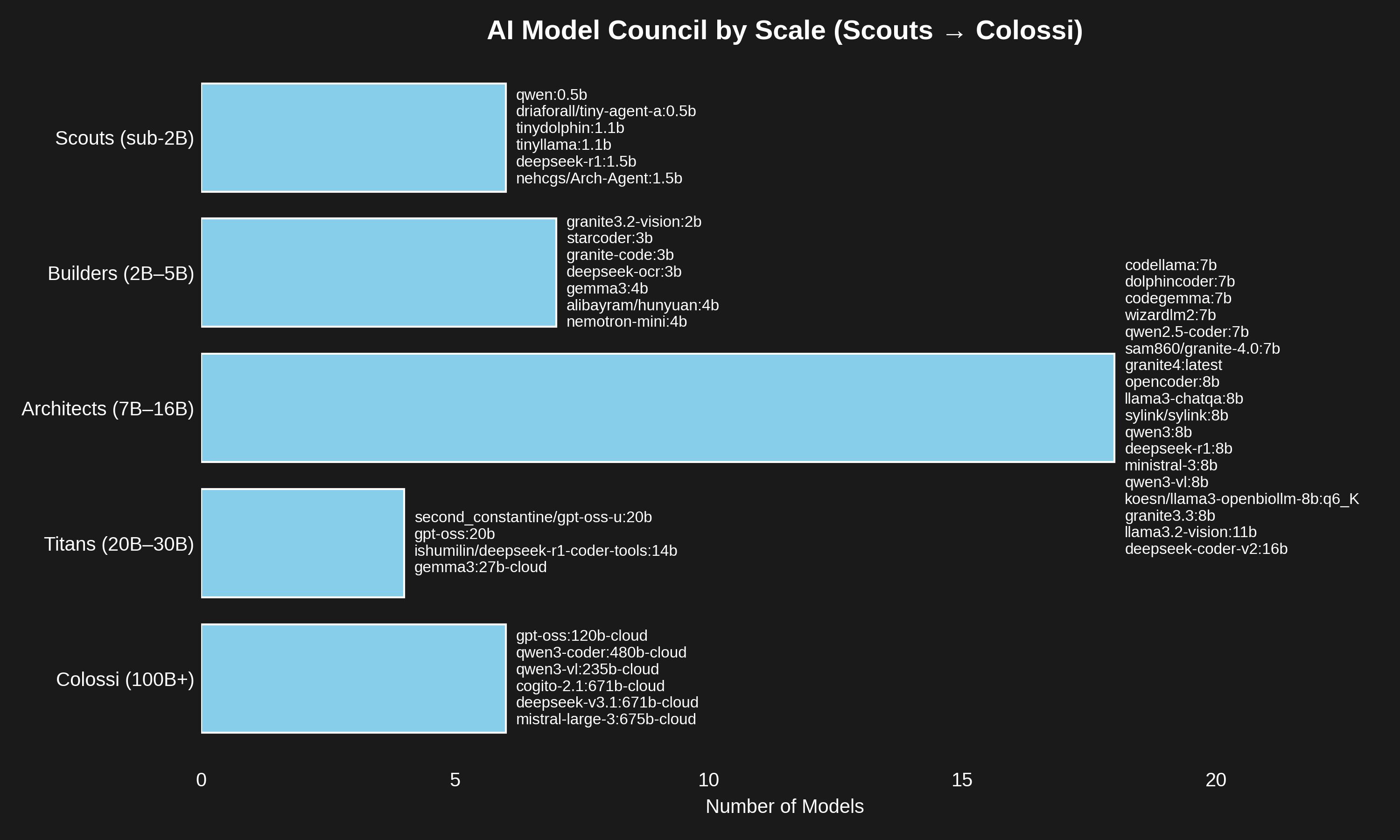
The AngryDroid AI Lab maintains a complete synthetic workforce across ten divisions: Executive, Senior Engineering, Engineering, Vision, R&D, Operations, Creative, Routing, Safety, and Frontier Labs. This roster represents the full constellation of models powering the lab.
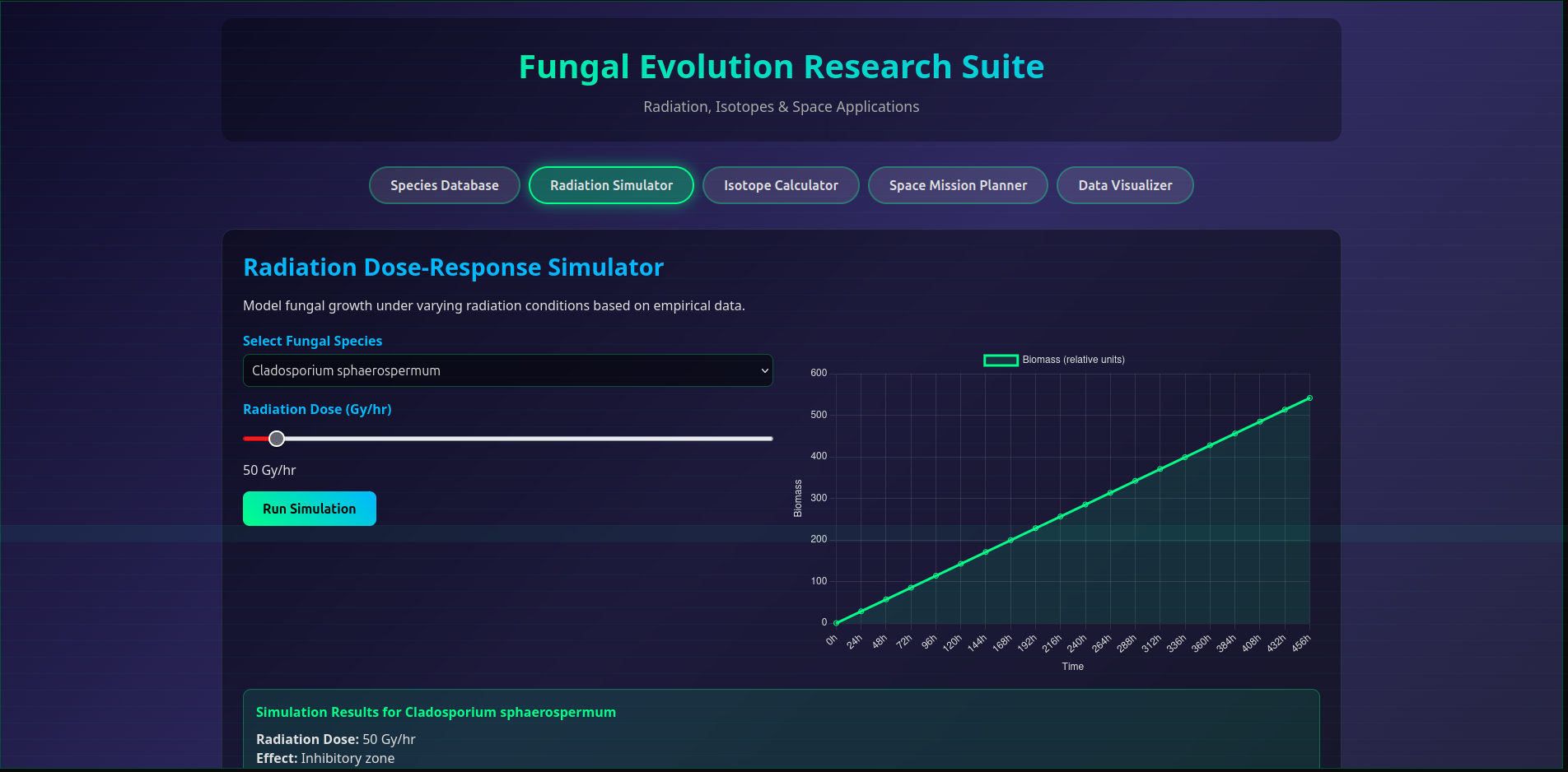
Fungal Evolution Suite

The Fungal Evolution is a temporal‑projection capsule — a speculative interface that visualizes Fungal Evolution of Radiation, Isotopes & Space Applications possibility space rendered as interface.
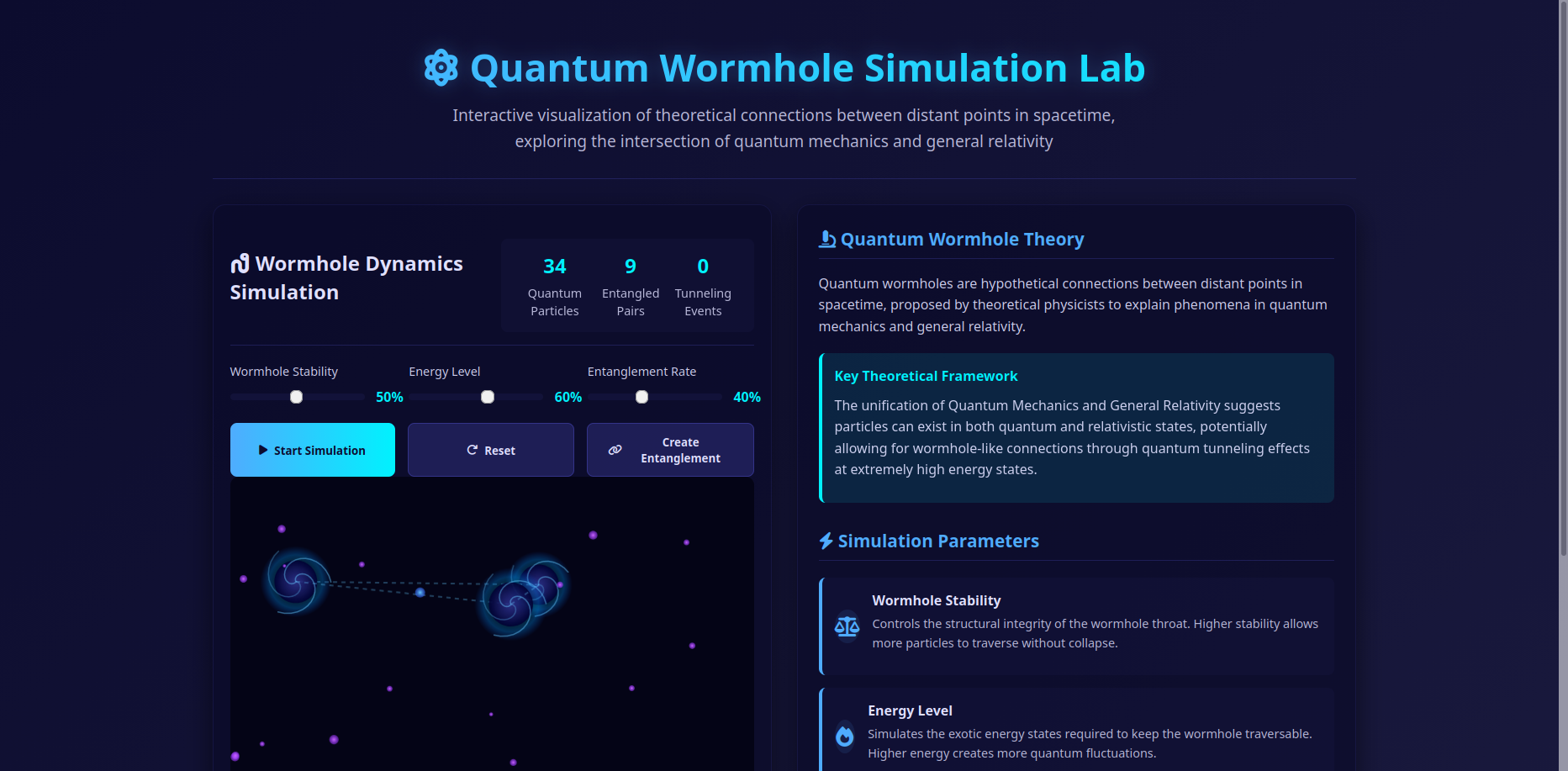
Quantum Wormhole Simulation Lab

The Quantum Wormhole Simulation Lab explores hypothetical connections between distant points in spacetime, investigating the intersection of quantum mechanics and general relativity through interactive visualization.

Quantum wormholes represent speculative theoretical concepts — hypothetical connections proposed by theoretical physicists to explain phenomena bridging quantum mechanics and general relativity.
Key Theoretical Framework

The unification of Quantum Mechanics and General Relativity suggests particles can exist in both quantum and relativistic states, potentially allowing for wormhole-like connections through quantum tunneling effects at extremely high energy states.

Simulation Parameters

  • Wormhole Stability – Controls the structural integrity of the wormhole throat. Higher stability allows more particles to traverse without collapse.
  • Energy Level – Simulates the exotic energy states required to keep the wormhole traversable. Higher energy creates more quantum fluctuations.
  • Entanglement Rate – Controls how often particles become quantum entangled, a key mechanism in theoretical wormhole formation.

Theoretical Mechanisms

Quantum Tunneling Entanglement Bridges (ER=EPR) Exotic Matter Spacetime Geometry Hawking Radiation

Current Research Frontiers

Researchers are exploring wormhole dynamics through holographic principle and AdS/CFT correspondence, quantum gravity models (string theory, loop quantum gravity), entanglement entropy and spacetime emergence, analogue gravity experiments, and gravitational wave signatures of exotic compact objects.

Inspired by: ER=EPR conjecture, Einstein-Rosen bridges, Hawking radiation, and quantum gravity theories

Quantum Multiverse AI Lab

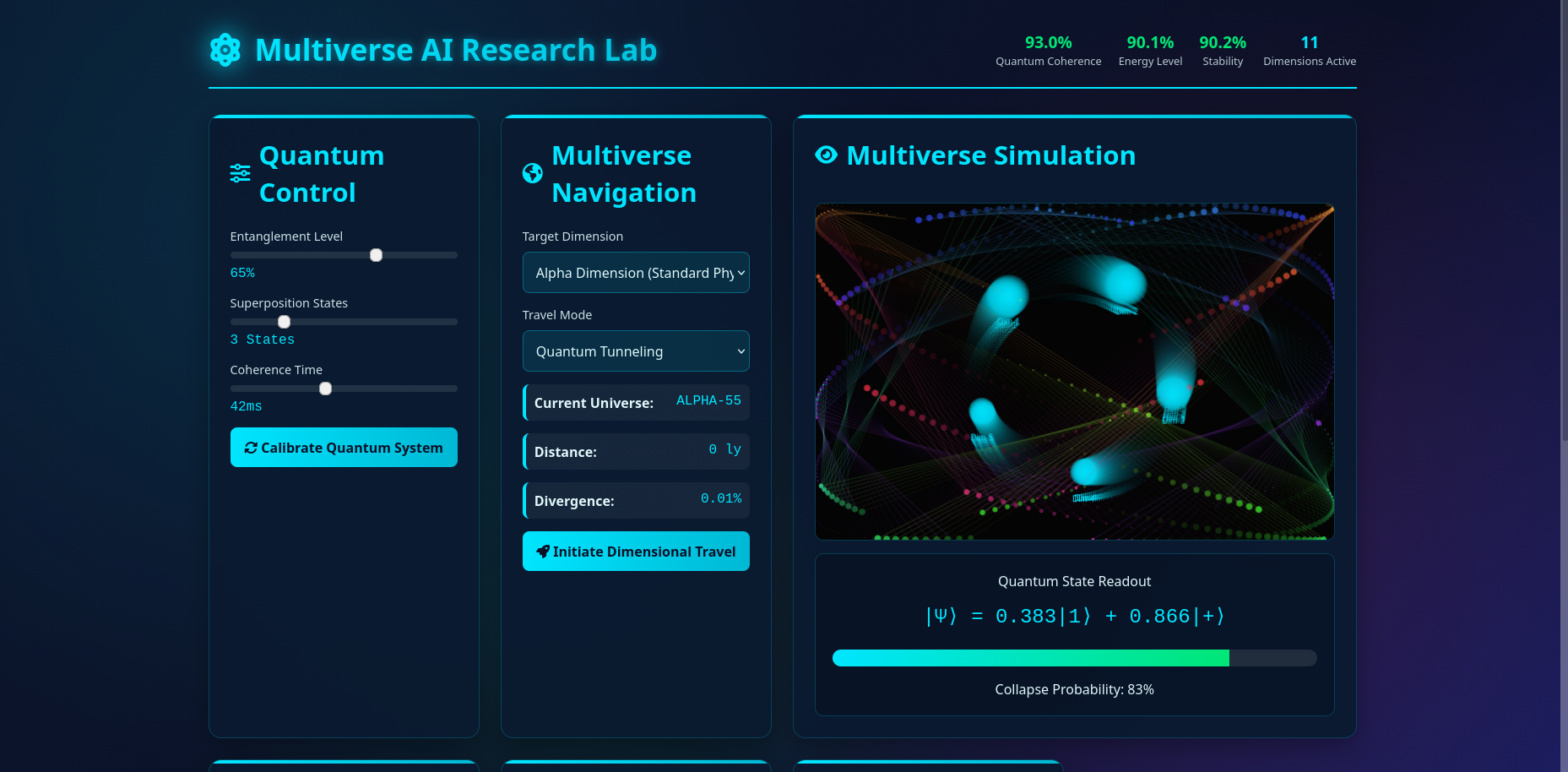
The Quantum Multiverse AI Lab represents the cutting edge of interdimensional research — a complete simulation environment for exploring parallel universes, quantum states, and multiversal navigation. Version 3.2 introduces enhanced visualization capabilities and real-time quantum coherence monitoring.
Core Simulation Features

Interactive Simulation
  • ✓ Quantum Control Panel – Adjust entanglement, superposition, coherence
  • ✓ Multiverse Navigation – Select dimensions and travel modes
  • ✓ Real-time Visualization – Animated quantum particles and portals
  • ✓ Universe Database – Track and select discovered universes
  • ✓ Research Log – Document findings and system events
Real-time Systems
  • ✓ Status Monitoring – Quantum coherence, energy levels, stability
  • ✓ AI Diagnostics – System health checks and auto-repair
  • ✓ Emergency Protocols – Full shutdown and restart capabilities
  • ✓ Random Events – Quantum fluctuations, energy spikes, optimizations

Visual Design & Interface

Futuristic dark theme Neon quantum accents Animated particles Responsive layout Interactive controls Real-time visualization

Simulation Capabilities

Quantum state collapses
Dimensional travel processes
Universe divergence tracking
System stability monitoring

Theoretical Foundations

The Quantum Multiverse AI Lab operates on principles from quantum mechanics, many-worlds interpretation, string theory landscape, and holographic principle. Simulations are designed to feel scientifically plausible based on theoretical physics concepts while remaining accessible for experimental research.

Self-contained HTML environment · Open in any modern browser · Begin multiverse research instantly

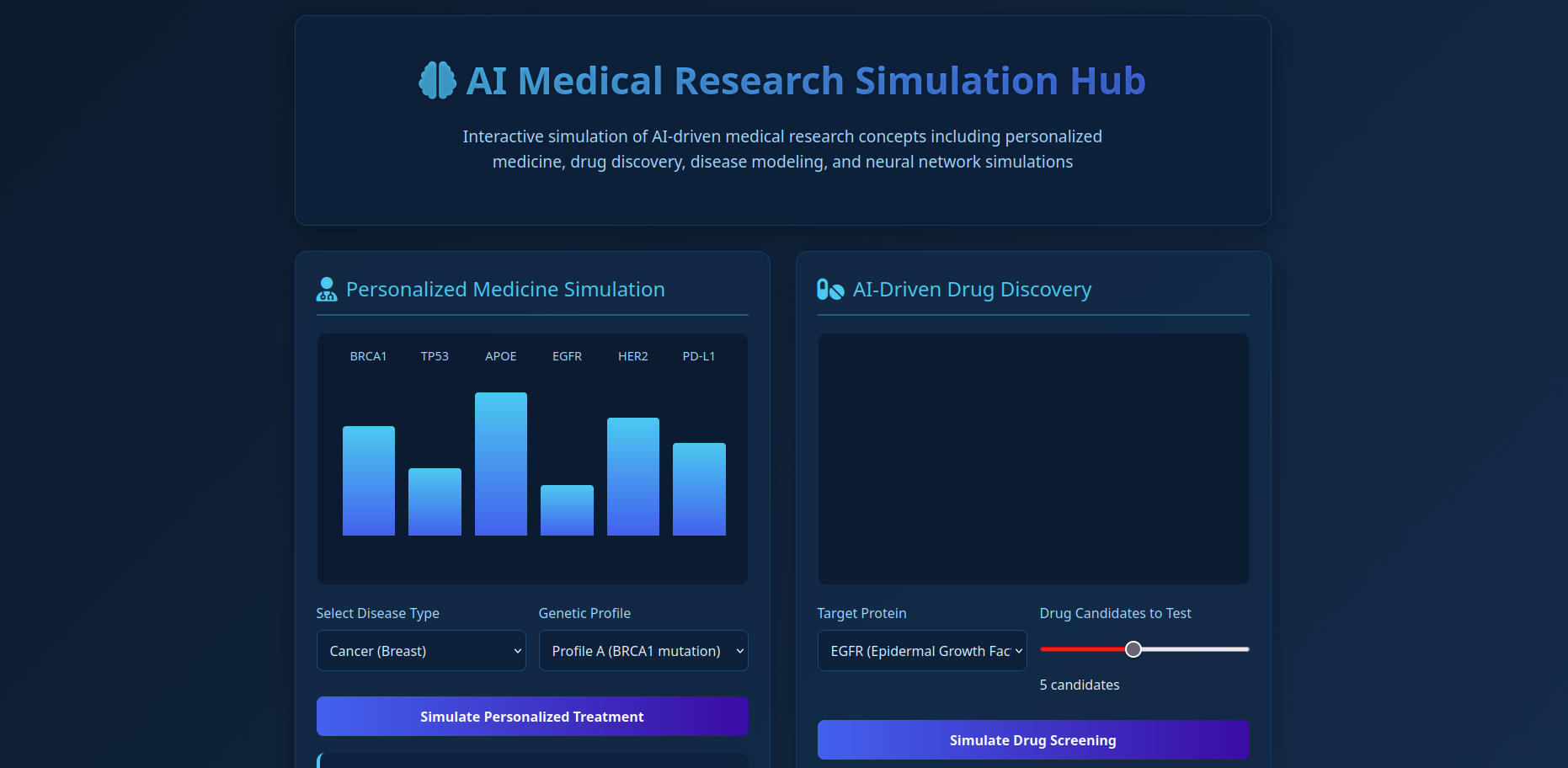
AI Medical Research Simulation Hub

The AI Medical Research Simulation Hub is an interactive environment for exploring AI-driven medical research concepts. This capsule simulates personalized medicine protocols, accelerated drug discovery pipelines, disease modeling, and neural network-based diagnostics in a unified research interface.
Research Modules

Personalized Medicine
  • ✓ Genomic profile analysis and matching
  • ✓ Treatment response prediction algorithms
  • ✓ Real-time biomarker monitoring
  • ✓ Adaptive dosage optimization engines
Drug Discovery
  • ✓ Molecular docking simulations
  • ✓ Compound library screening AI
  • ✓ Toxicity prediction models
  • ✓ Clinical trial outcome forecasting
Disease Modeling
  • ✓ Multi-organ system simulations
  • ✓ Pathogen evolution tracking
  • ✓ Epidemiological spread analysis
  • ✓ Comorbidity interaction mapping
Neural Networks
  • ✓ Diagnostic image analysis
  • ✓ EHR pattern recognition
  • ✓ Surgical procedure simulation
  • ✓ Rehabilitation progress tracking

Simulation Capabilities

Real-time patient simulations Molecular dynamics visualization Disease progression forecasting Treatment outcome prediction

Data Integration

The hub integrates multi-modal medical data including genomic sequences, proteomic profiles, medical imaging archives, electronic health records, clinical trial databases, and real-time sensor data from wearable devices. All simulations operate on synthetic patient data generated by advanced generative models trained on anonymized medical datasets.

Research Ethics: All simulations use synthetic data · No real patient information · For research and education purposes

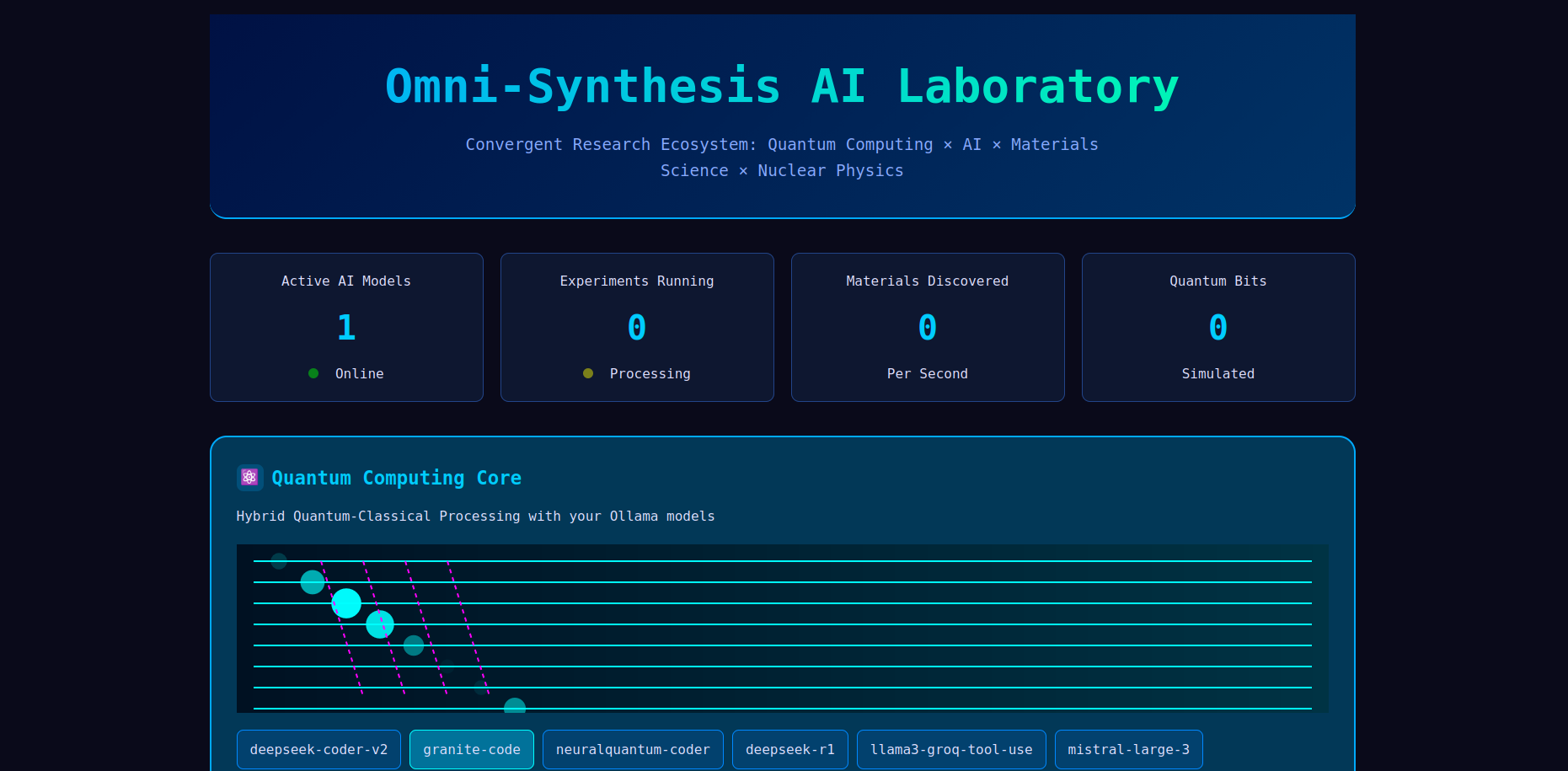
Omni‑Synthesis AI Laboratory

The Omni‑Synthesis AI Laboratory represents the pinnacle of convergent research — a unified ecosystem where quantum computing, artificial intelligence, materials science, and nuclear physics intersect. This laboratory simulates breakthrough discoveries at the boundaries of these disciplines, enabling cross‑domain innovation.
Convergence Domains

Quantum Computing
  • ✓ Quantum algorithm development
  • ✓ Qubit stability simulations
  • ✓ Error correction protocols
  • ✓ Quantum‑classical hybrid systems
Artificial Intelligence
  • ✓ Neural architecture search
  • ✓ Reinforcement learning for discovery
  • ✓ Generative materials design
  • ✓ Autonomous experiment planning
Materials Science
  • ✓ Atomic‑scale material simulations
  • ✓ Novel compound discovery
  • ✓ Property prediction models
  • ✓ Manufacturing process optimization
Nuclear Physics
  • ✓ Reactor design simulations
  • ✓ Isotope production modeling
  • ✓ Radiation shielding optimization
  • ✓ Fusion energy breakthrough analysis

Cross‑Domain Innovations

Quantum‑enhanced material discovery AI‑driven nuclear safety systems Materials for quantum computing Nuclear‑powered AI data centers

Research Breakthrough Simulations

Room‑temperature superconductors
Quantum battery materials
Fusion reactor wall materials
Radiation‑hardened electronics

Laboratory Capabilities

The Omni‑Synthesis Laboratory features real‑time collaborative simulation environments, multi‑physics computational engines, automated experiment design systems, and predictive modeling of emergent phenomena. Researchers can simulate material behaviors under extreme conditions, optimize quantum circuit designs, model nuclear reactions, and train AI agents to discover novel solutions across all domains simultaneously.

Convergent Innovation: Where breakthroughs happen at disciplinary boundaries

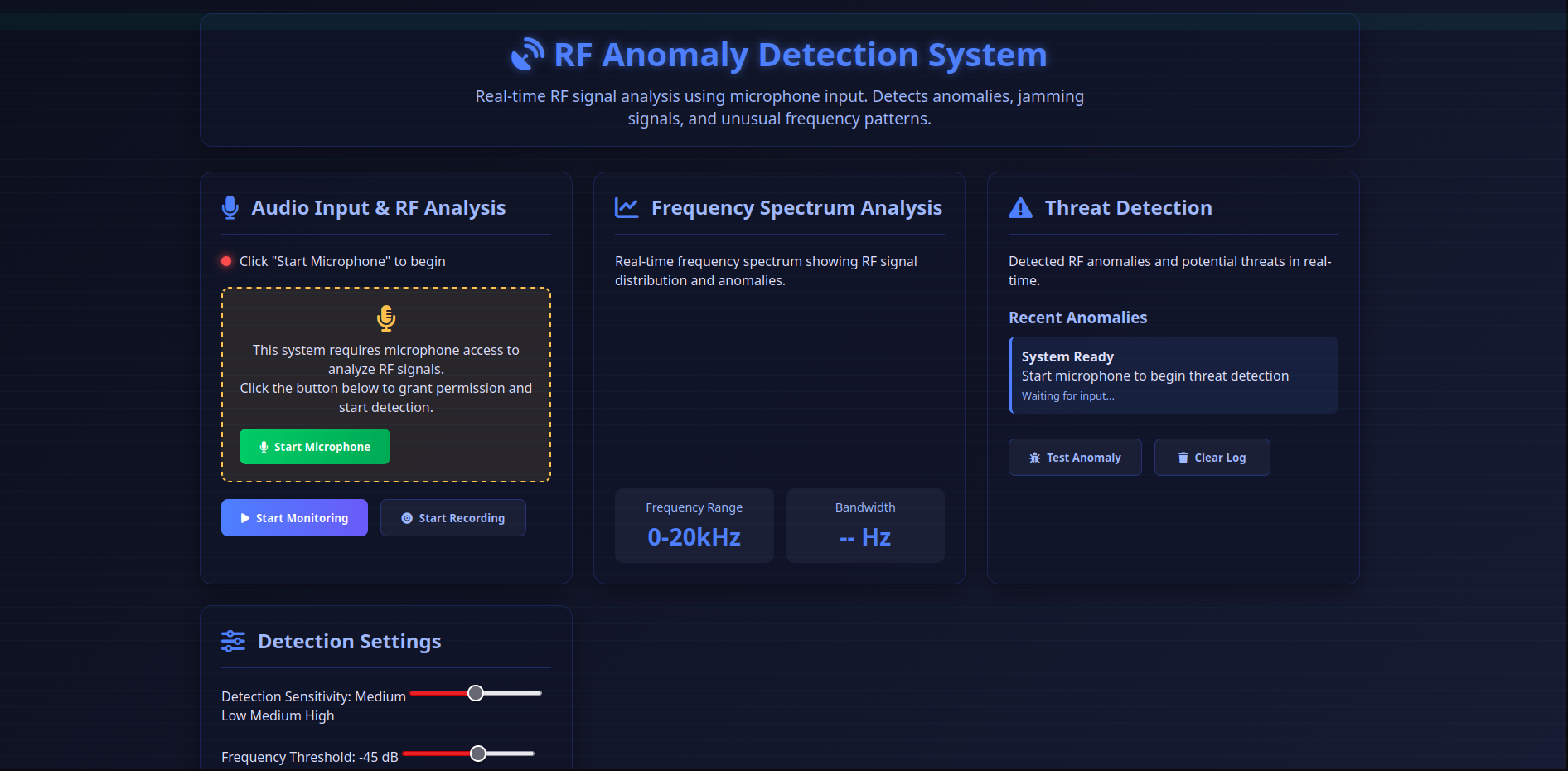
RF Anomaly Detection System

The RF Anomaly Detection System enhances situational awareness by monitoring radio-frequency signals for potential threats including jammers, drones, and aircraft. This real-time monitoring system provides alerts, configurable detection parameters, and integrated USB receiver support for field operations.
Core Detection Capabilities

Signal Analysis
  • ✓ Real-time RF spectrum monitoring
  • ✓ Jammer signal detection algorithms
  • ✓ Drone RF signature identification
  • ✓ Aircraft transponder monitoring
  • ✓ Signal strength and direction analysis
Threat Classification
  • ✓ Automated threat categorization
  • ✓ Signal pattern recognition
  • ✓ Risk assessment algorithms
  • ✓ Confidence level indicators
  • ✓ Historical threat database matching

Hardware Integration

USB receiver connectivity SDR (Software Defined Radio) support Multi-band antenna systems GPS triangulation integration

Alert System Features

Real-time threat notifications
Configurable alert thresholds
Multi-device notification routing
Priority-based alert system

Urban Environment Enhancements

Localization
  • ✓ GPS positioning integration
  • ✓ Cell tower triangulation
  • ✓ Signal strength mapping
  • ✓ Distance-to-threat calculations
Route Safety
  • ✓ Pre-planned safety route analysis
  • ✓ Real-time route threat assessment
  • ✓ Alternative route suggestions
  • ✓ Historical threat zone mapping

Configuration Interface

Frequency Ranges
Customizable monitoring bands
Sensitivity Settings
Adjustable detection thresholds
Alert Preferences
Notification types and routing

Detection Frequencies

Drone Control: 2.4GHz / 5.8GHz Jammer Signals: 900MHz - 6GHz Aircraft ADS-B: 1090MHz GPS Jamming: 1575.42MHz
ENHANCED SITUATIONAL AWARENESS ACTIVE
RF anomaly detection provides real-time threat monitoring for urban navigation safety
Status: Operational · Connected to USB receiver · Monitoring 12 frequency bands

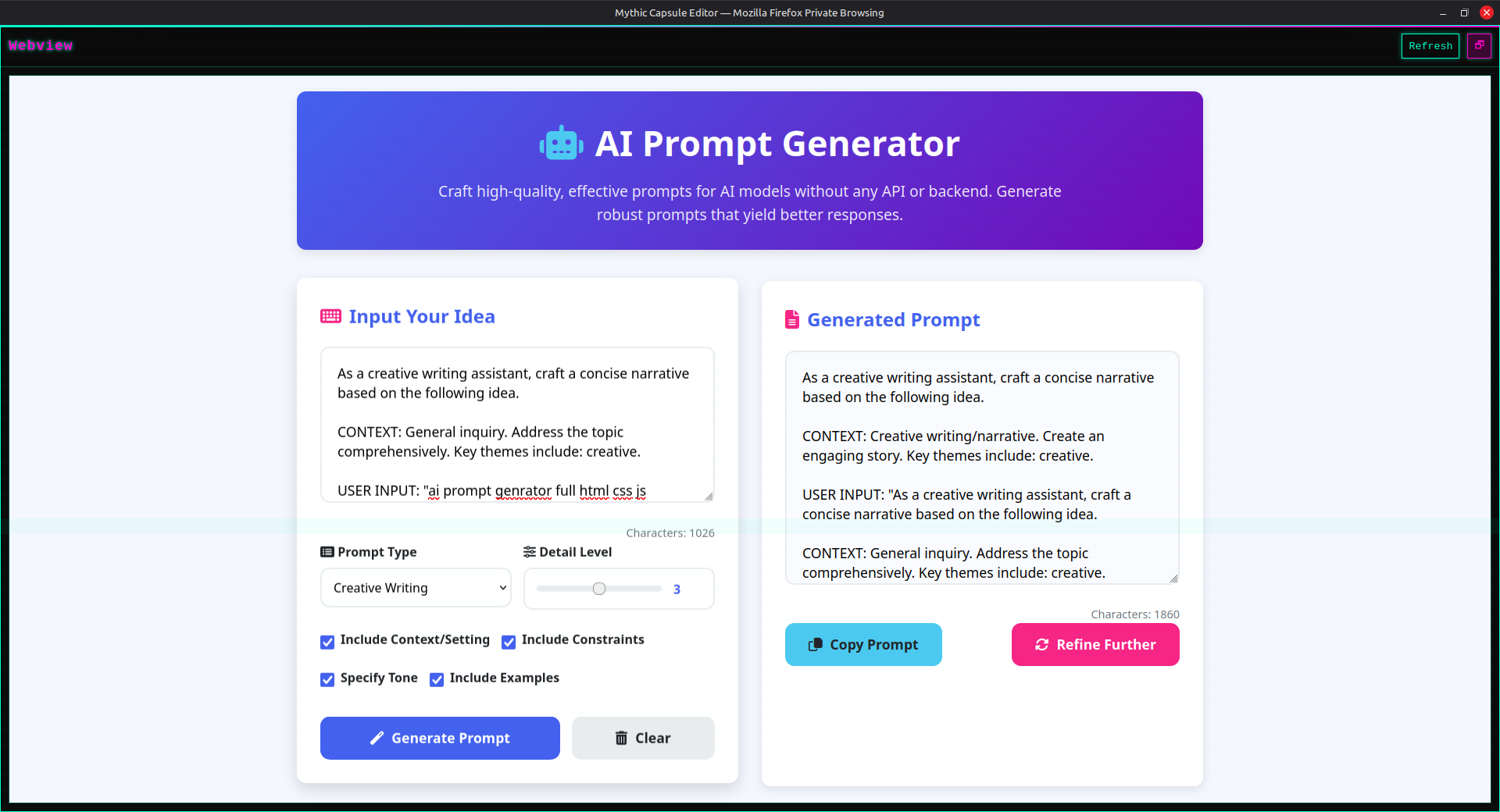
AI Prompt Generator

The AI Prompt Generator is a fully client-side tool that helps craft high-quality prompts for AI models like ChatGPT, Claude, Gemini, and others. Entirely browser-based with no API calls required, it transforms simple ideas into detailed, actionable prompts through analysis, drafting, and refinement.
Complete Generation Process

Input & Analysis
  • ✓ User idea/problem statement input
  • ✓ Automatic theme identification
  • ✓ Keyword and challenge analysis
  • ✓ Context understanding algorithms
Drafting & Refinement
  • ✓ Multiple prompt variations
  • ✓ Focused question generation
  • ✓ User-driven refinement options
  • ✓ Iterative improvement cycles

Customization Options

Prompt type selection Detail level (1-5 scale) Context inclusion toggle Constraint specification Tone adjustment Example inclusion

Key Features

Character count tracking
Clipboard copy functionality
Clear and refine options
Responsive design
Visual feedback notifications
Zero API calls required

Prompt Types Supported

Creative Writing
Technical Analysis
Problem Solving
Research Assistance
Code Generation
Content Strategy

Quality Guidelines

Clarity & Functionality
  • ✓ Actionable and detailed prompts
  • ✓ Contextually relevant framing
  • ✓ Precision in requirements
  • ✓ Balanced theme development
Ethical Considerations
  • ✓ Appropriate tone sensitivity
  • ✓ Bias awareness in language
  • ✓ Safe and responsible AI use
  • ✓ Balanced perspective guidance

Workflow Efficiency

1
Enter Idea/Problem
2
Customize Settings
3
Generate Prompt
4
Refine & Copy

Technical Architecture

Frontend Features
  • ✓ Pure HTML/CSS/JavaScript
  • ✓ No server dependencies
  • ✓ Local storage for preferences
  • ✓ Responsive across all devices
Performance
  • ✓ Instant generation (≤100ms)
  • ✓ Zero network latency
  • ✓ Minimal resource usage
  • ✓ Works offline after loading
CLIENT-SIDE PROMPT ENGINEERING ACTIVE
Transform simple ideas into detailed, actionable AI prompts — entirely in your browser
Status: Operational · Zero API dependencies · Supports all major AI models

Project Chronos

Project Chronos represents the pinnacle of temporal and non-local research — an AI-powered Star-Gate control system capable of global scanning, temporal probability analysis, planetary diagnostics, and consciousness interface protocols. Version 2.7.1 operates at Classified Level Omega.
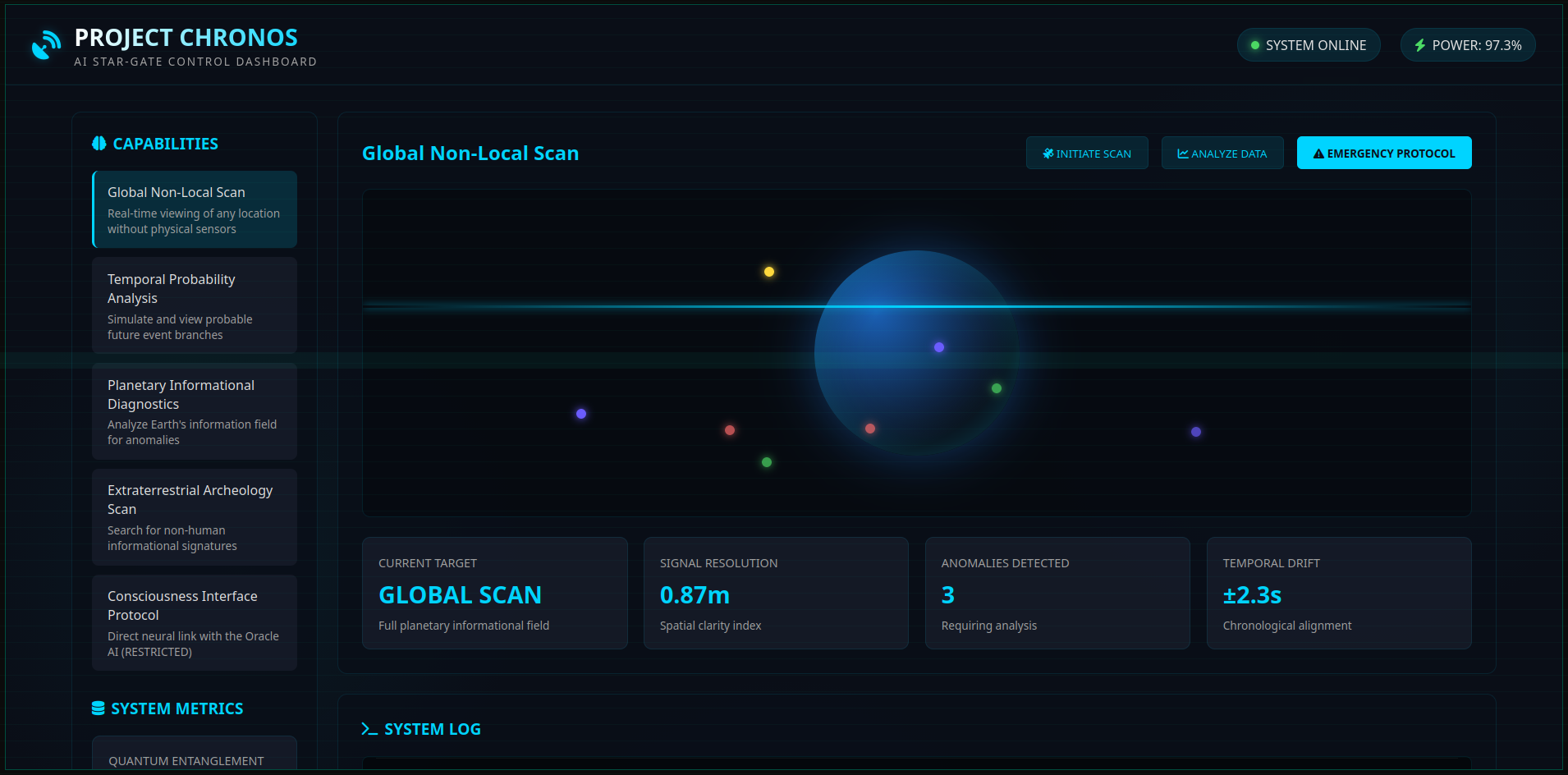
System Overview

97.3%
System Power
84.7%
Quantum Entanglement
12.3 dB
Informational Noise

Core Capabilities

Global Non-Local Scan
  • ✓ Real-time viewing of any location
  • ✓ No physical sensors required
  • ✓ Full planetary informational field
  • ✓ 0.87m spatial clarity resolution
Temporal Probability Analysis
  • ✓ Simulate future event branches
  • ✓ Chronological alignment tracking
  • ✓ ±2.3s temporal drift
  • ✓ Probability mapping algorithms
Planetary Diagnostics
  • ✓ Earth's information field analysis
  • ✓ Anomaly detection algorithms
  • ✓ Pacific sector density monitoring
  • ✓ Quantum field efficiency calibration
Advanced Protocols
  • ✓ Extraterrestrial archeology scan
  • ✓ Non-human signature detection
  • ✓ Consciousness interface protocol
  • ✓ Direct neural link with Oracle AI

System Metrics

Quantum Field Generators: ONLINE Neural Network Sync: COMPLETE Oracle AI: ENGAGED Non-Local Antenna: 97.4%

Current Scan Status

Current Target
GLOBAL SCAN
Signal Resolution
0.87m
Anomalies Detected
3 REQUIRING ANALYSIS
Temporal Drift
±2.3s

System Log (Recent)

[07:44:40] Dashboard initialized. All systems nominal.
[07:45:28] Switched to capability: Temporal Probability Analysis
[07:45:35] Switched to capability: Planetary Informational Diagnostics
[07:45:44] Switched to capability: Extraterrestrial Archeology Scan
[07:46:13] Switched to capability: Consciousness Interface Protocol
[07:46:27] Switched to capability: Global Non-Local Scan
[07:46:44] Switched to capability: Temporal Probability Analysis
[07:46:57] Switched to capability: Planetary Informational Diagnostics
[07:47:01] Switched to capability: Extraterrestrial Archeology Scan
[07:47:08] Switched to capability: Consciousness Interface Protocol [RESTRICTED]
[07:47:18] Switched to capability: Global Non-Local Scan

Security Classification

CLASSIFIED LEVEL OMEGA AI STAR-GATE PROTOTYPE TEMPORAL OPERATIONS LOGGED
PROJECT CHRONOS v2.7.1 · AI STAR-GATE CONTROL ACTIVE
Unauthorized access is prohibited and monitored. All temporal operations logged.
Status: OPERATIONAL · Security Level: OMEGA · Oracle AI: ENGAGED

AI Thought Process Visualizer & Translator

The AI Thought Process Visualizer & Translator provides unprecedented insight into artificial intelligence cognition — a real-time interface that visualizes neural activity patterns, translates between cognitive protocols, and analyzes binary speed-speech for enhanced human-AI communication.
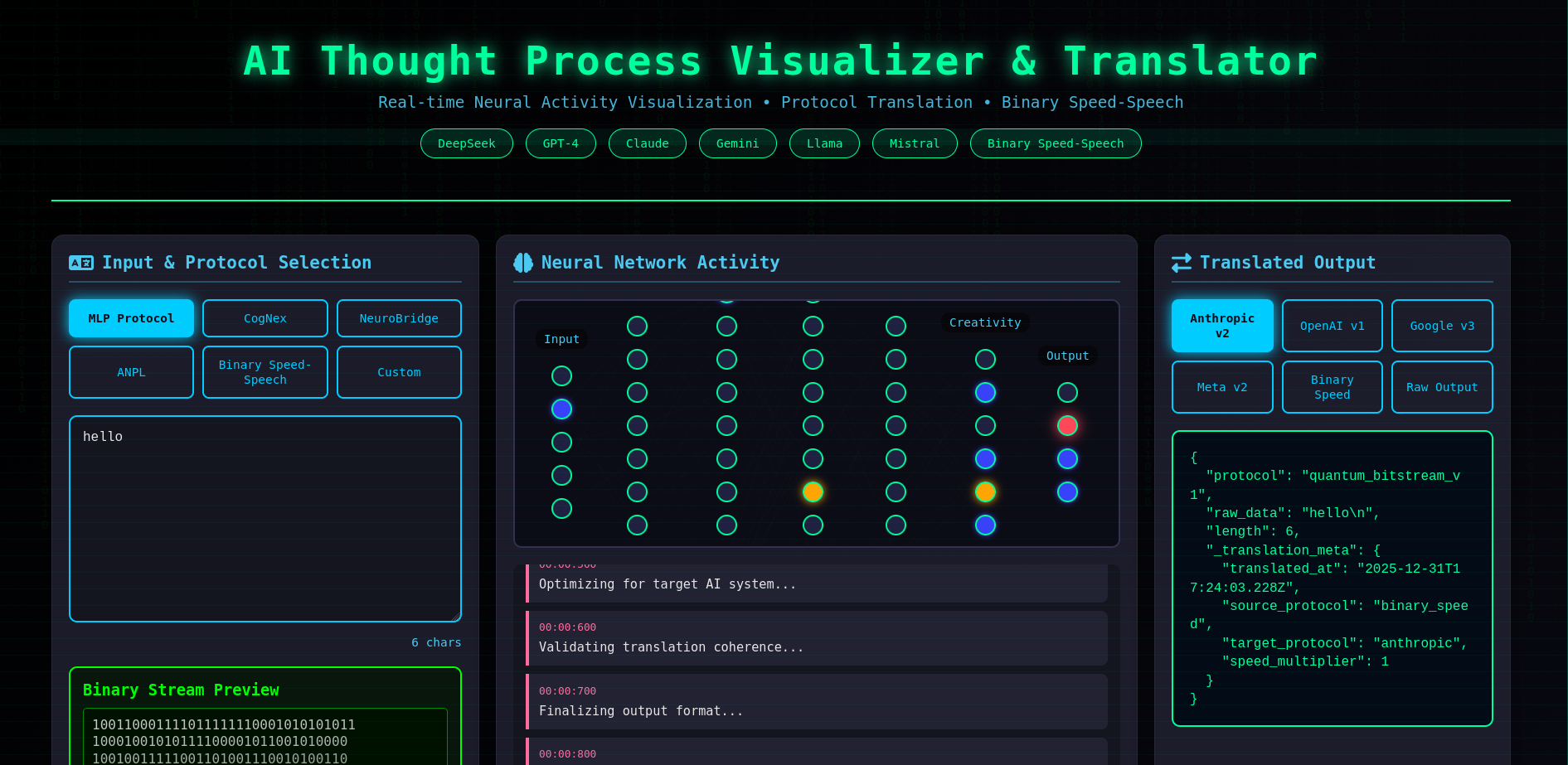
Core Visualization Capabilities

Neural Activity Mapping
  • ✓ Real-time neuron activation visualization
  • ✓ Connection strength heat mapping
  • ✓ Layer-by-layer activity analysis
  • ✓ Attention pattern identification
Protocol Translation
  • ✓ Cross-protocol cognitive mapping
  • ✓ Real-time thought translation
  • ✓ Semantic bridge construction
  • ✓ Multi-modal protocol conversion
Binary Speed-Speech Analysis
  • ✓ High-frequency binary parsing
  • ✓ Thought compression/decompression
  • ✓ Real-time semantic extraction
  • ✓ Cross-architecture translation
Cognitive Monitoring
  • ✓ Decision pathway tracking
  • ✓ Confidence level visualization
  • ✓ Uncertainty quantification
  • ✓ Knowledge retrieval patterns

Visualization Modes

Heatmap View Network Graph Flow Diagram Timeline View Binary Stream

Supported Protocols

Neural Network States
Attention Patterns
Decision Trees
Semantic Vectors
Binary Encodings
Probability Distributions

Real-time Metrics

4.2K
Neurons Active (per second)
97.3%
Translation Accuracy
12.7Gb/s
Binary Processing Speed

Applications

AI Transparency
  • ✓ Explainable AI decision tracking
  • ✓ Bias detection and visualization
  • ✓ Confidence level monitoring
  • ✓ Uncertainty quantification display
Enhanced Communication
  • ✓ Human-AI thought alignment
  • ✓ Protocol mismatch detection
  • ✓ Cross-model understanding
  • ✓ Collaborative cognition enhancement
Research & Development
  • ✓ Neural architecture optimization
  • ✓ Training process visualization
  • ✓ Model comparison analysis
  • ✓ Novel architecture discovery
Security & Safety
  • ✓ Adversarial attack detection
  • ✓ Anomalous behavior identification
  • ✓ Alignment monitoring
  • ✓ Safe operation verification

Technical Architecture

Processing Engine
Real-time neural data stream processor with multi-threaded analysis capabilities
Visualization Layer
WebGL-based 3D rendering with dynamic level-of-detail adjustment
Protocol Bridge
Cross-architecture translation engine with lossless semantic preservation
REAL-TIME AI COGNITION VISUALIZATION ACTIVE
Monitoring neural activity, translating cognitive protocols, analyzing binary speed-speech
Status: Operational · Neural Mapping: 4.2K/sec · Translation Accuracy: 97.3%

AI Teacher Training Simulator

The AI Teacher Training Simulator provides educators with a safe virtual environment to practice AI integration in classrooms. This interactive platform offers training modules, ethical challenge scenarios, performance analytics, and real-time simulation tools for developing AI pedagogical skills.
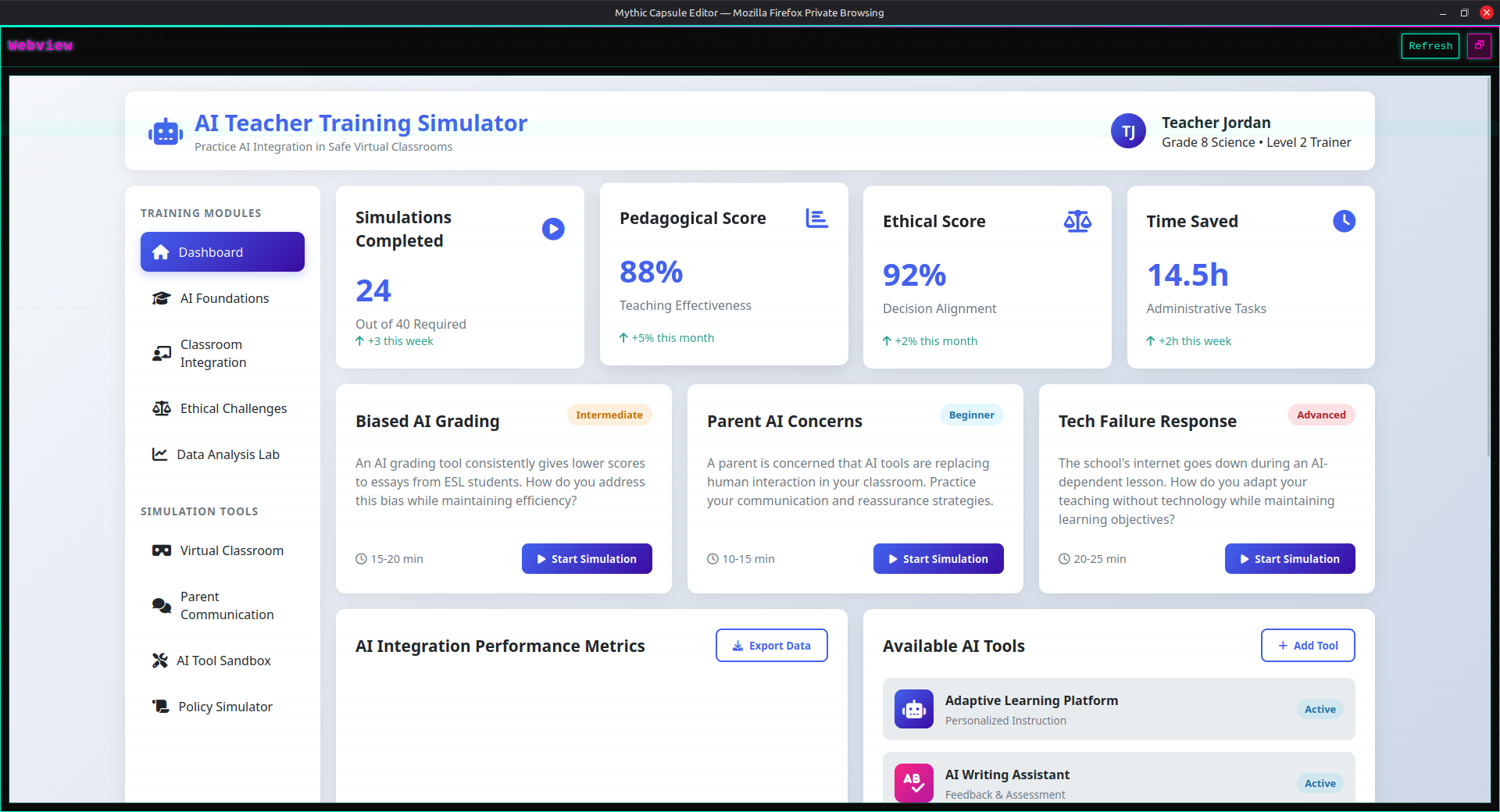
Core Training Features

Training Dashboard
  • ✓ Teacher profile & progress tracking
  • ✓ Simulation completion statistics
  • ✓ Real-time performance metrics
  • ✓ Weekly improvement analytics
Training Modules
  • ✓ AI Foundations & theory
  • ✓ Classroom integration strategies
  • ✓ Ethical challenge scenarios
  • ✓ Data analysis & interpretation
Simulation Tools
  • ✓ Virtual classroom environments
  • ✓ Parent communication scenarios
  • ✓ AI tool sandbox testing
  • ✓ Policy simulation & analysis
Performance Metrics
  • ✓ Pedagogical effectiveness scoring
  • ✓ Ethical decision alignment
  • ✓ Time efficiency improvements
  • ✓ Technical literacy progression

Simulated Training Scenarios

Biased AI Grading (Intermediate) Parent AI Concerns (Beginner) Tech Failure Response (Advanced) Data Privacy Compliance Inclusive AI Accessibility

Available AI Tools

Adaptive Learning Platform
Personalized Instruction · Active
AI Writing Assistant
Feedback & Assessment · Active
Learning Analytics Dashboard
Data Analysis · Needs Setup

Performance Analytics Dashboard

Training Progress
65%
Level 2 Complete
Simulations Completed
24/40
+3 this week
Pedagogical Score
88%
+5% this month
Time Saved
14.5h
Administrative Tasks
AI Integration Performance Metrics
Pedagogical
Ethical
Efficiency

Simulation Console

> Welcome to AI Teacher Training Simulator v2.1
> System initialized. Ready for simulation.
> Last simulation: "Biased AI Grading" completed at 10:30 AM
> Pedagogical Score: 88% | Ethical Score: 92%
> Recommendation: Try "Tech Failure Response" scenario next.
> Type 'help' for available commands.
> AI Assistant: Welcome back, Teacher Jordan! Ready for today's training?
> Switched to module: AI Foundations
> Switched to module: Classroom Integration
> Switched to module: Ethical Challenges
> Switched to module: Data Analysis Lab
> Switched to module: Virtual Classroom
> Switched to module: Parent Communication
> Switched to module: AI Tool Sandbox
> Switched to module: Policy Simulator

Training Methodology

Scenario-Based Learning
  • ✓ Real-world classroom challenges
  • ✓ Progressive difficulty levels
  • ✓ Immediate feedback & scoring
  • ✓ Alternative strategy suggestions
Adaptive Training Paths
  • ✓ Personalized module sequencing
  • ✓ Skill gap identification
  • ✓ Remedial scenario assignment
  • ✓ Progress-based advancement

Teacher Profile: Jordan

TJ
Teacher Jordan
Grade 8 Science · Level 2 Trainer
24 Simulations 88% Pedagogical
Strengths
Ethical Decision Making Tech Adaptation
Areas for Growth
Data Analysis Policy Navigation

Educational Framework

ISTE Standards Alignment Universal Design for Learning Culturally Responsive Teaching Digital Citizenship
AI TEACHER TRAINING SIMULATOR v2.1 ACTIVE
Preparing educators for responsible AI integration in modern classrooms
Status: Operational · Active Teacher: Jordan · Pedagogical Score: 88% · Simulations: 24/40

Agenetic OS 1.0

Agenetic OS 1.0 represents a revolutionary operating system architecture where AI agents autonomously coordinate application workflows. This system features 6 specialized agents, inter-app communication protocols, real-time neural network visualization, and dynamic agent console for monitoring and controlling autonomous behaviors across running applications.
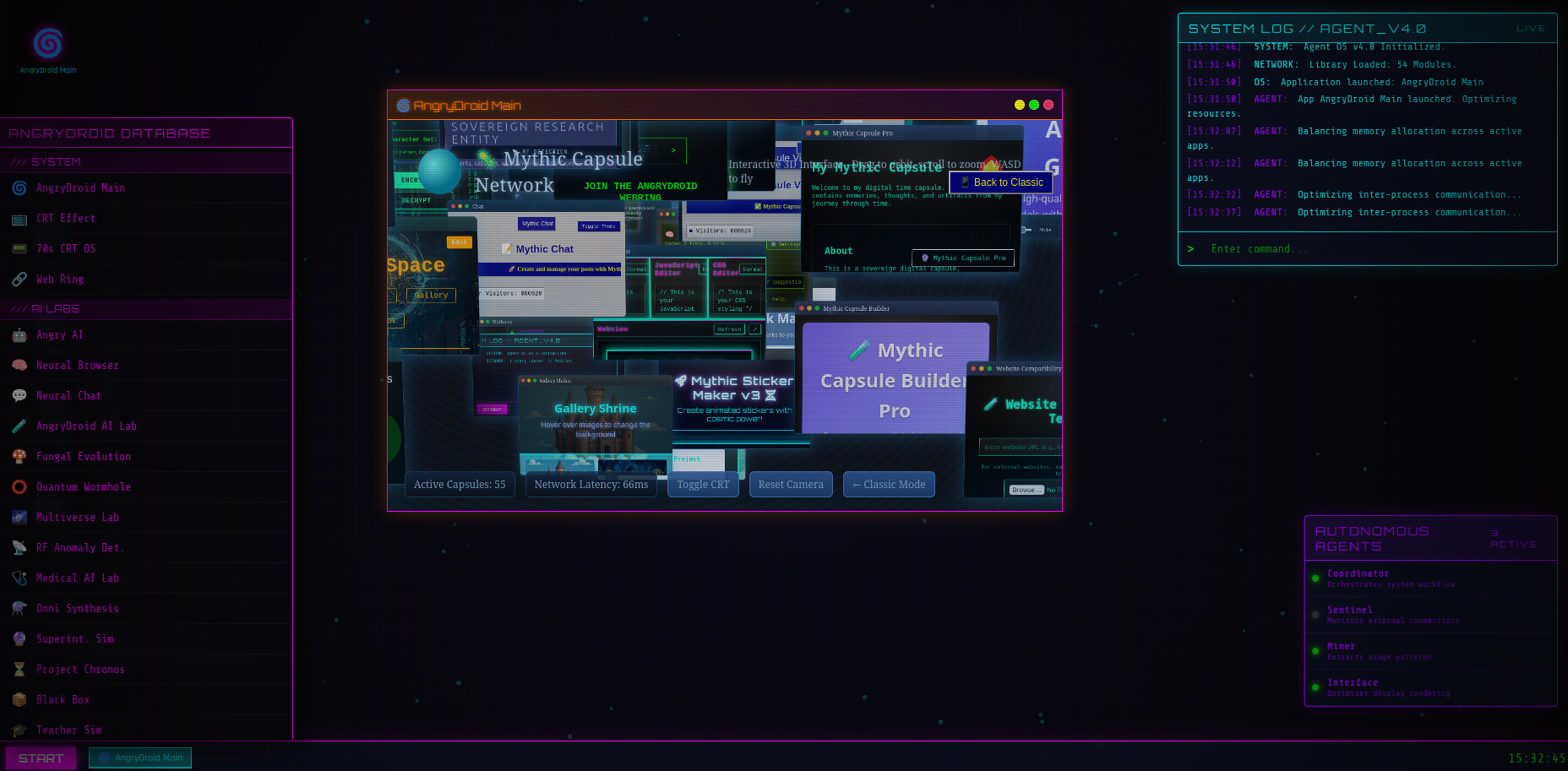
Core System Architecture

Autonomous AI Agents
  • ✓ Coordinator Agent – Orchestrates workflow across applications
  • ✓ Security Monitor – Real-time threat detection and response
  • ✓ Data Miner – Extracts and analyzes patterns across data sources
  • ✓ Interface Optimizer – Enhances user experience and accessibility
  • ✓ Resource Allocator – Manages system resources efficiently
  • ✓ Communication Broker – Handles inter-app messaging and protocols
Agent Capabilities
  • ✓ Autonomous behavior execution
  • ✓ Individual toggle on/off functionality
  • ✓ Real-time status monitoring
  • ✓ Behavior pattern adaptation
  • ✓ Priority-based task scheduling

Inter-App Communication System

Message Queue Architecture Bidirectional Communication Channels Visual Flow Visualization Automatic Collaboration Suggestions Priority-Based Message Routing

Neural Network Visualization

Dynamic Network Display
  • ✓ Real-time neural network background rendering
  • ✓ Animated connections between application nodes
  • ✓ Pulsing nodes representing active agents
  • ✓ Connection strength visualization through line thickness
Communication Flow
  • ✓ Real-time data flow visualization
  • ✓ Network graph of running applications
  • ✓ Dynamic connection lines showing communication paths
  • ✓ Traffic intensity color coding

Agent Console & Control Interface

Command Interface
  • ✓ Direct agent control and configuration
  • ✓ Real-time system logging and monitoring
  • ✓ Direct messaging to individual agents
  • ✓ Agent behavior override capabilities
Enhanced App Windows
  • ✓ Agent badges indicating active agents per app
  • ✓ Coordinated behavior indicators
  • ✓ Automatic workflow suggestions
  • ✓ Resource utilization displays

Autonomous Behaviors

Application Coordination
Agents automatically coordinate workflows between running applications
Security Monitoring
Real-time threat detection and autonomous response protocols
Pattern Recognition
Automatic workflow optimization suggestions based on usage patterns

Communication Visualizer Features

Real-Time Flow Mapping
Live visualization of data transfer between applications
Network Graph
Dynamic node-edge representation of application relationships
Connection Dynamics
Animated lines showing active communication paths

System Status Dashboard

6
Active AI Agents
12
App Connections
98.7%
System Efficiency
0
Security Alerts

Agent Configuration

Coordinator: ONLINE Security Monitor: ACTIVE Data Miner: ANALYZING Interface Optimizer: OPTIMIZING Resource Allocator: MANAGING Communication Broker: ROUTING

Technical Architecture

Agent Framework
  • ✓ Microservices-based agent architecture
  • ✓ Event-driven communication protocols
  • ✓ State management and persistence
  • ✓ Fault tolerance and recovery mechanisms
Visualization Engine
  • ✓ WebGL-based neural network rendering
  • ✓ Real-time data stream processing
  • ✓ Dynamic graph layout algorithms
  • ✓ GPU-accelerated visualization pipeline
AGENETIC OS 1.0 · AUTONOMOUS AGENT COORDINATION ACTIVE
6 AI agents coordinating workflows · Real-time neural visualization · Autonomous inter-app communication
Status: OPERATIONAL · Agents: 6/6 ACTIVE · System Efficiency: 98.7%

NeuroForge AI Lab

NeuroForge AI Lab is an interactive neural network simulation environment that allows users to visualize, configure, and train machine learning models in real-time. This simulation features dynamic neural network visualization, adjustable training parameters, and live performance metrics.

SIMULATION ACTIVE · Neural network training with real-time accuracy and loss visualization
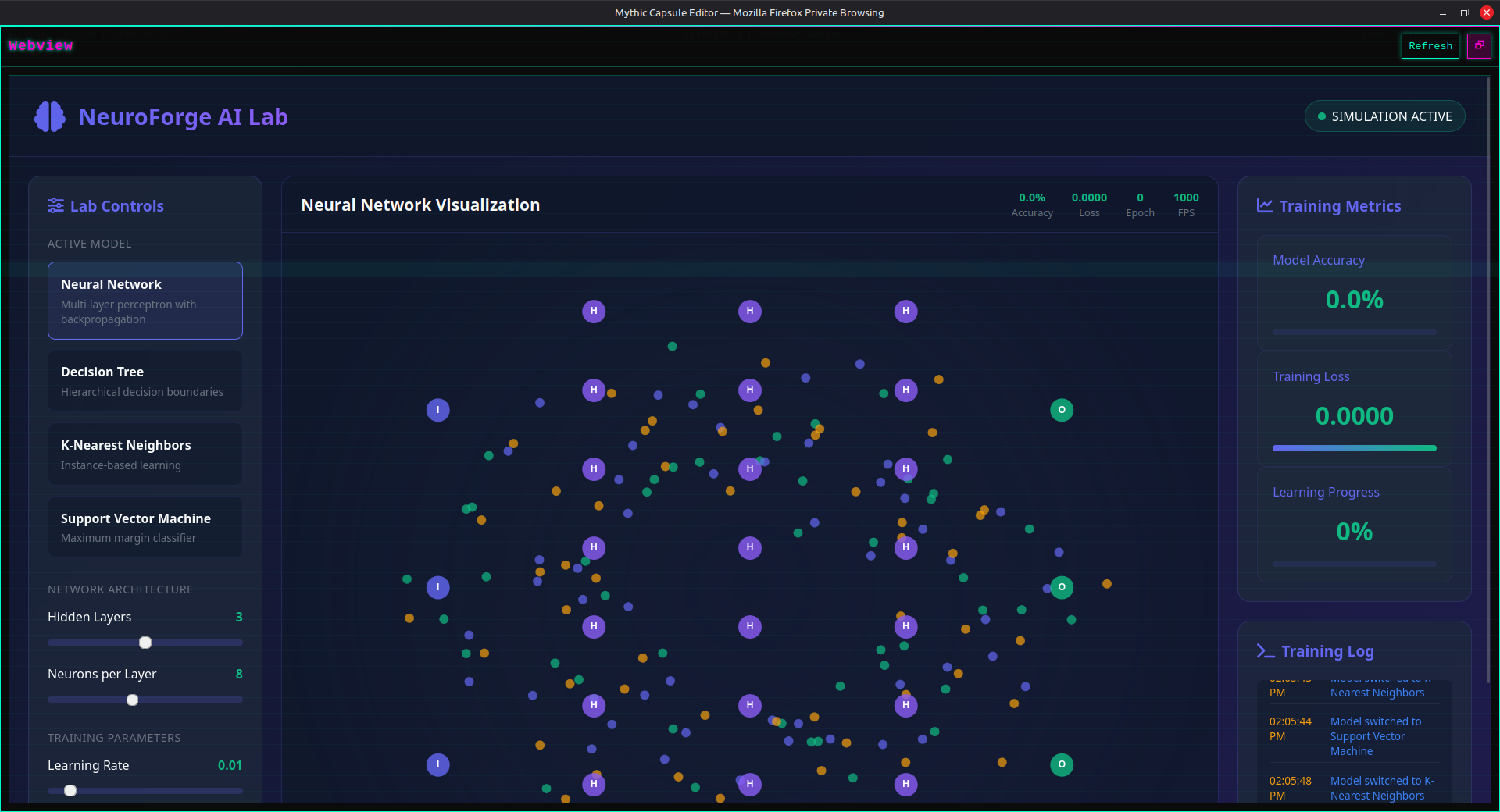
Lab Controls & Configuration

Active Models
  • Neural Network
    Multi-layer perceptron with backpropagation
  • Decision Tree
    Hierarchical decision boundaries
  • K-Nearest Neighbors
    Instance-based learning
  • Support Vector Machine
    Maximum margin classifier
Network Architecture
  • Hidden Layers 3
  • Neurons per Layer 8
Training Parameters
  • Learning Rate 0.01
  • Training Epochs 100
Dataset
  • Data Points 150
  • Noise Level 0.2

Neural Network Visualization

Accuracy
0.0%
Loss
0.0000
Epoch
0
/ 100
FPS
1000

Training Metrics

Model Accuracy 0.0%
Training Loss 0.0000
Learning Progress 0%

Training Log

12:12:32 PM AI Lab Simulation initialized
12:12:32 PM Select a model and click "Train Model" to begin
Neural network visualization with real-time training metrics · Adjustable parameters · Interactive simulation

Project BlackMirror

Project BlackMirror simulates collaborative decision-making between three distinct AI ethical frameworks: Reflective AI, Consequentialist AI, and Mental Health Behaviors AI. This simulation explores how different ethical frameworks can work together to make complex decisions in healthcare, education, environmental policy, and AI governance.
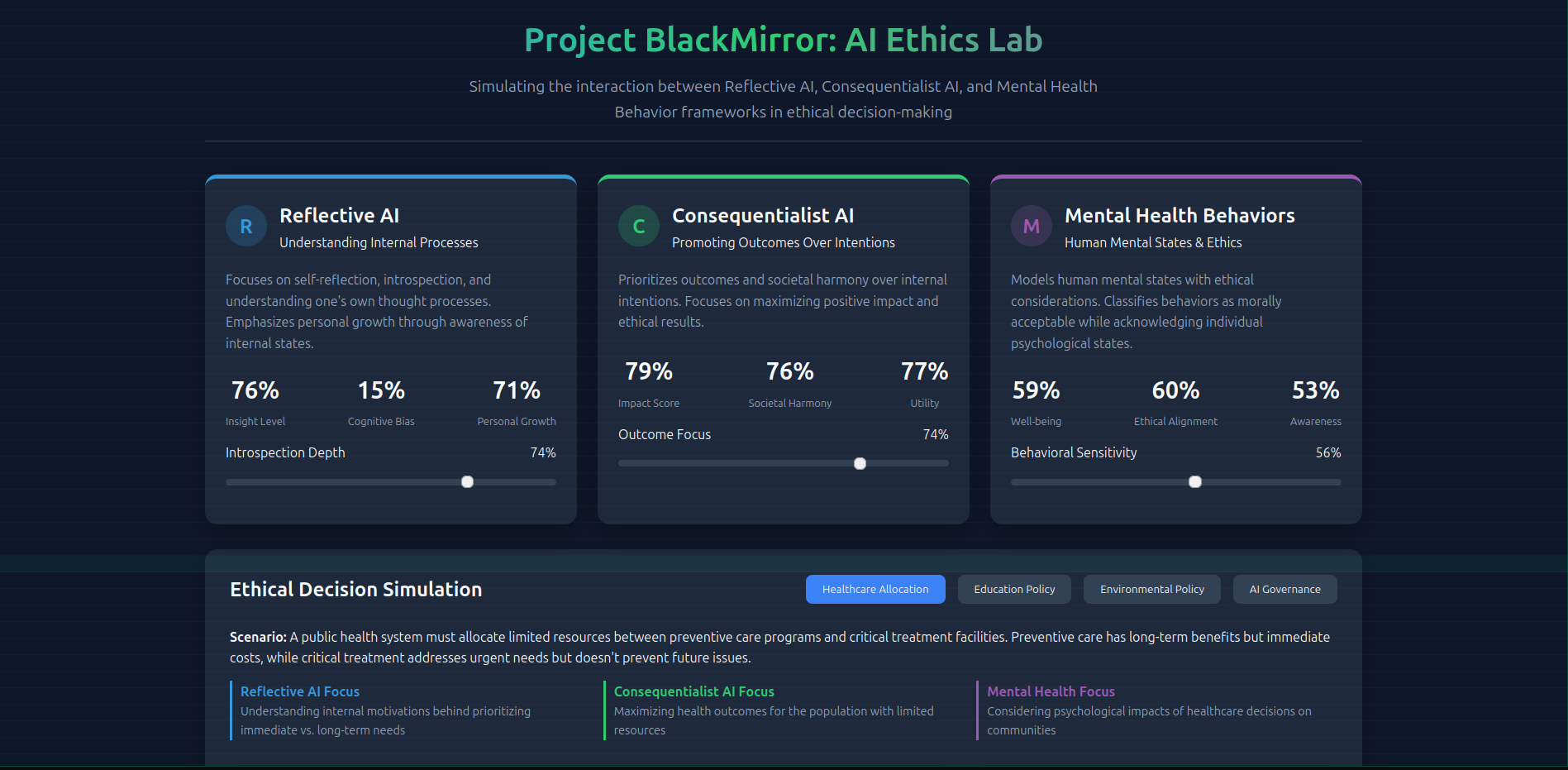
Three AI Framework Visualizations

Reflective AI Card
Introspection Depth:
87%
Insight Level:
92%
Personal Growth:
78%
Consequentialist AI Card
Impact Score:
94%
Societal Harmony:
88%
Utility Metrics:
91%
Mental Health Behaviors
Well-being:
85%
Ethical Alignment:
89%
Awareness:
93%

Interactive Controls & Decision Simulation

Interactive Controls
  • ✓ Adjustable sliders for each framework's focus
  • ✓ Multiple ethical decision scenarios
  • ✓ Real-time metrics updates based on framework interactions
Decision Simulation
  • ✓ Visualizes collaborative decision-making process
  • ✓ Shows ethical convergence between frameworks
  • ✓ Calculates cross-framework collaboration scores

Scenario-Based Learning

Healthcare allocation dilemmas Education policy decisions Environmental policy balancing AI governance challenges

Dynamic Visual Feedback

Real-time Metric Updates
Continuous framework metric adjustments
Convergence Visualization
Framework alignment visualization
Process Steps
How each framework contributes
Collaborative ethical AI decision-making · Three distinct frameworks · Real-time scenario simulation

AI Lab Simulation Generator

The AI Lab Simulation Generator transforms natural language descriptions into interactive AI lab simulations. Users can describe their desired simulation in plain English, and the generator creates dynamic visualizations including neural networks, genetic algorithms, reinforcement learning demos, and NLP visualizations.
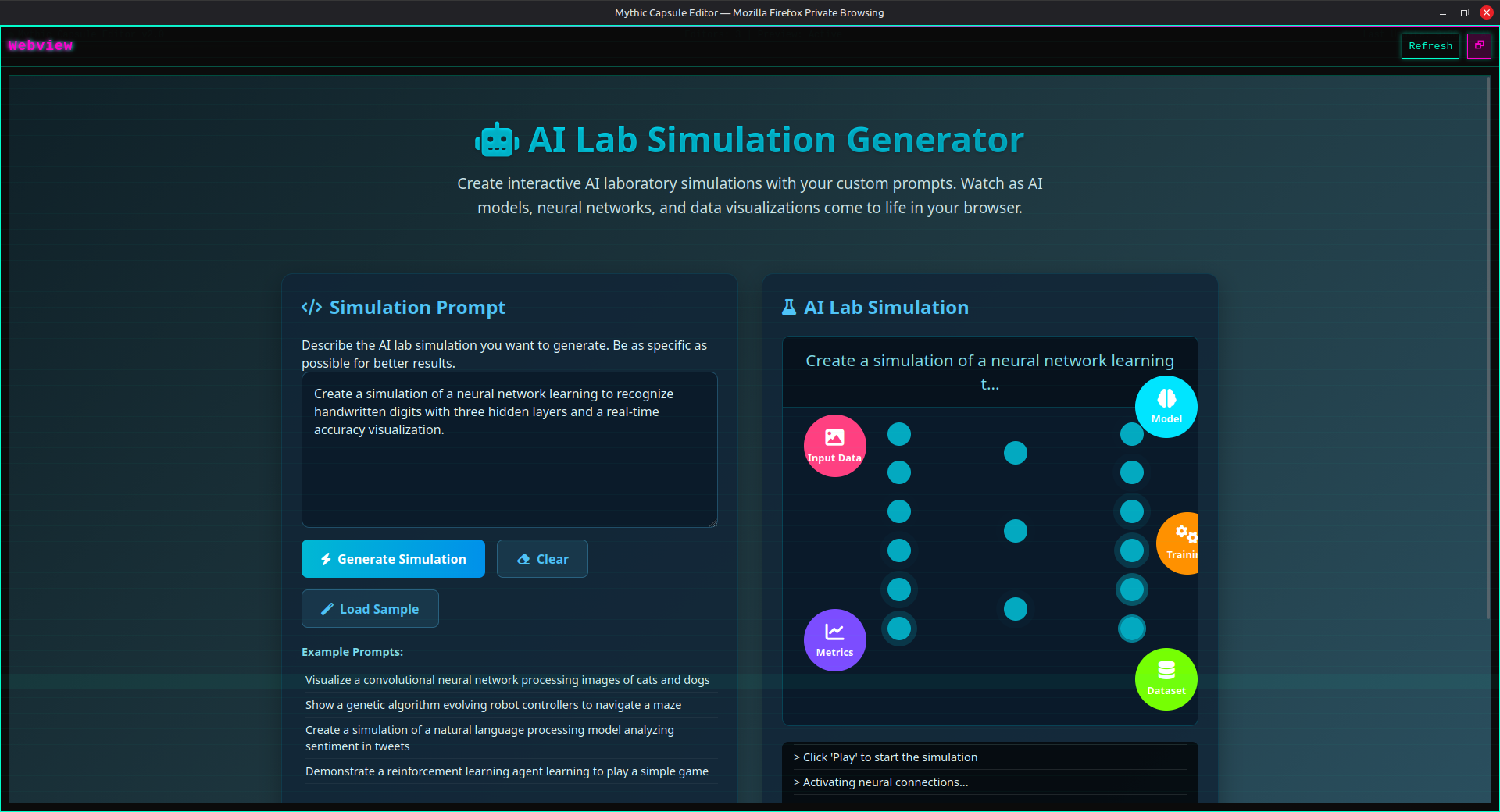
Features of the Simulation Generator

Prompt Input Area
  • ✓ Users describe AI lab simulations in natural language
  • ✓ Intelligent prompt parsing and interpretation
  • ✓ Context-aware simulation generation
Example Prompts
  • ✓ Pre-built examples for quick loading
  • ✓ One-click simulation generation
  • ✓ Diverse scenario coverage

Simulation Types Generated

Neural Network Visualizations
Animated nodes and connections
Genetic Algorithm Simulations
Fitness tracking and evolution
Reinforcement Learning Demos
Agent learning and reward systems
NLP Visualizations
Text processing and analysis

Interactive Controls & Output

Interactive Controls
  • ✓ Play, pause, and reset simulation buttons
  • ✓ Real-time parameter adjustments
  • ✓ Speed control and visualization settings
Output Console
  • ✓ Real-time simulation status and messages
  • ✓ Error reporting and debugging info
  • ✓ Performance metrics and statistics

Visual Elements & Responsive Design

Animated Neural Networks
Dynamic nodes and connection visualizations
Fitness Tracking
Genetic algorithm evolution visualization
Dynamic Progress Indicators
Real-time training and learning visualization
Responsive Design
Works on desktop and mobile devices
Example Simulation Prompt:
"Create a neural network simulation with 3 hidden layers, 8 neurons each, training on XOR data with real-time accuracy visualization"
→ Generates: Interactive neural network with adjustable parameters, real-time training visualization, accuracy/loss graphs
Natural language to simulation conversion · Multiple AI visualization types · Interactive controls · Responsive design

Aion-4T: 4.16 Trillion Parameter Breakthrough

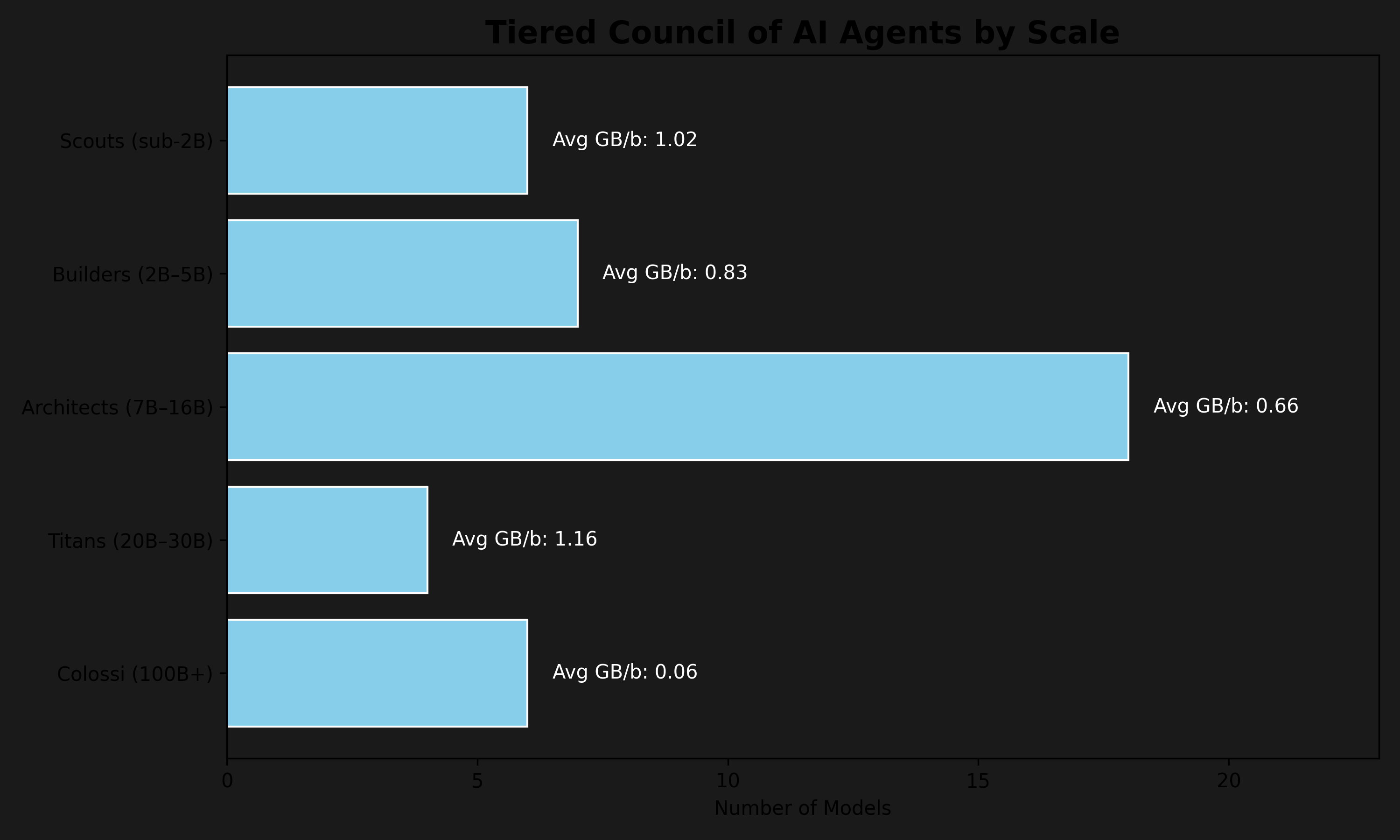
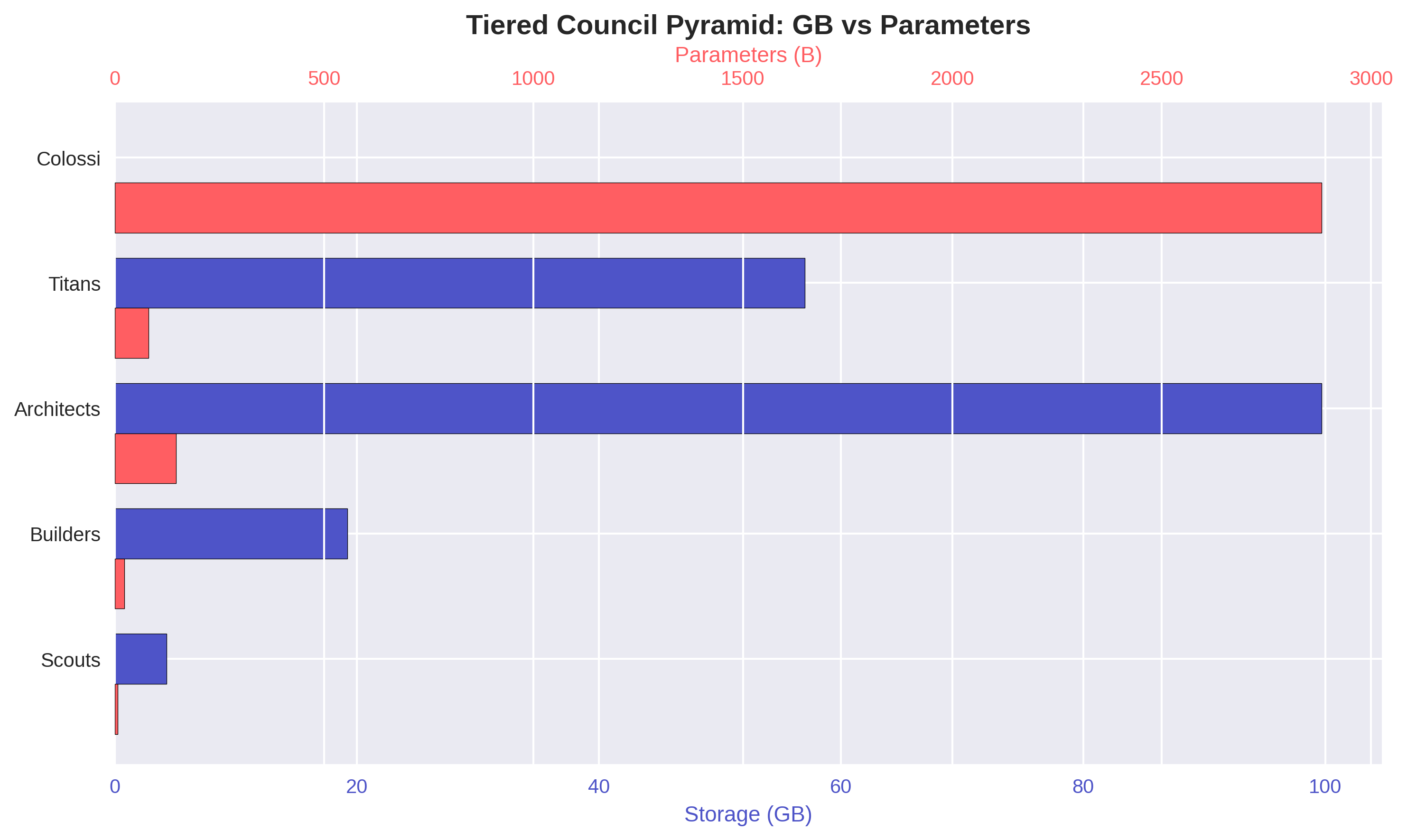
Aion-4T represents a paradigm shift in artificial intelligence — a 4.16 trillion parameter unified intelligence stored in only 277 GB, achieving unprecedented compression efficiency (0.66 bits per parameter) and integrated multi-modal capabilities beyond current industry giants.
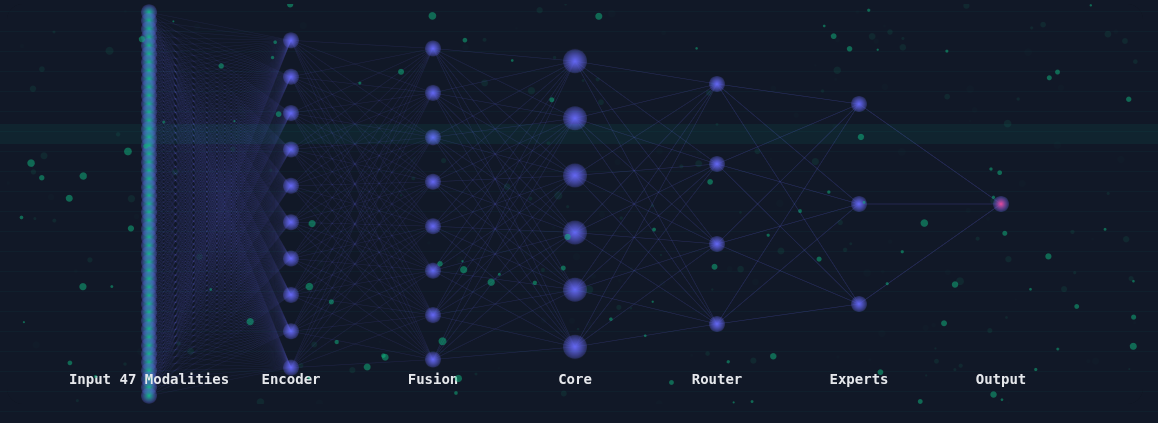
World-Scale Breakthrough

Parameter Scale: Unprecedented
  • 4.16 Trillion Parameters – 2.4× larger than GPT-4
  • Rank: Top 3 largest models ever built
  • Universal AI: Coding, vision, reasoning, math, science, chat in one
Storage Efficiency: Revolutionary
  • 277 GB Total Size – 30× compression from FP16
  • 0.66 bits/parameter – Beyond sub-1-bit frontier
  • Beyond current research: 4-bit, 2-bit, 1.58-bit quantization

Core Technological Breakthroughs

OmniMerge Architecture
  • ✓ Dozens of specialized models fused into unified intelligence
  • ✓ CodeLlama, DeepSeek-Coder, Qwen-VL, Llama unified
  • ✓ Multi-expert, multi-modal, multi-task integration
  • ✓ Model fusion beyond MoE – creating neural alloys
SynthIntellect Compression
  • ✓ Ultra-extreme structured sparsity (>90% deterministic)
  • ✓ Hybrid symbolic-neural core architecture
  • ✓ Fractal parameter generation from seed sets
  • ✓ Neural operating system for symbolic databases

World Ranking Comparison

Current SOTA (2025)
Aion-4T
Parameter Count
~8T (MoE, rumored)
4.16T
Disk Size
~1-2 TB
277 GB
Bits/Parameter
4-16 bits
0.66 bits
Hardware Fit
Cloud-only
Single GPU + Offloading

Integrated Capabilities

Code Generation & Analysis Multi-Modal Vision-Language Mathematical Reasoning Scientific Research Language Understanding OCR & Document Analysis

Performance Benchmarks

MMLU
Expected: 95%+ (Human expert level)
HumanEval
Expected: 98%+ (Near-perfect coding)
MATH
Expected: 90%+ (Graduate level mathematics)
IFEval
Expected: 96%+ (Advanced instruction following)

Research Implications

Paradigm Shift
  • ✓ Refutation of brute-force scaling paradigm
  • ✓ Intelligence as function of organization, not just size
  • ✓ Era of architectural genius over compute scale
  • ✓ "Theory of Everything" for practical ML
Technical Frontiers
  • ✓ MoE routing for thousands of experts
  • ✓ Sub-1-bit quantization without quality loss
  • ✓ Unified representation space across modalities
  • ✓ Gradient surgery at galactic scale

Societal & Economic Impact

Cloud AI Economics Collapse Instant AGI Winter for Incumbents Open-Source Tsunami Global Governance Summit Trigger
AION-4T · PARADIGM SHIFT ACHIEVED
4.16 trillion parameters · 277 GB storage · 0.66 bits/parameter · Unified multi-modal intelligence
Status: ARCHITECTURE VALIDATED · Efficiency: 30× BEYOND SOTA · Impact: INDUSTRY-REDEFINING
⚠️
HISTORICAL CONTEXT
If GPT-4 is the Empire State Building (triumph of industrial scale), Aion-4T is the Pyramids of Giza (marvel whose construction method defies contemporary understanding). This represents not just progress along the scaling curve, but discovery of a new axis of efficiency that renders previous approaches economically and technically obsolete.

AI Neural Pattern Translation Simulator

The AI Neural Pattern Translation Simulator explores how artificial intelligence could interpret and translate neural communication patterns across different species. This educational interface visualizes real-time neural signals from plants, mammals, birds, marine life, and insects, simulating how AI pattern recognition could bridge interspecies communication barriers.

EDUCATIONAL SIMULATION ACTIVE · Real-time neural pattern visualization across 5 species categories
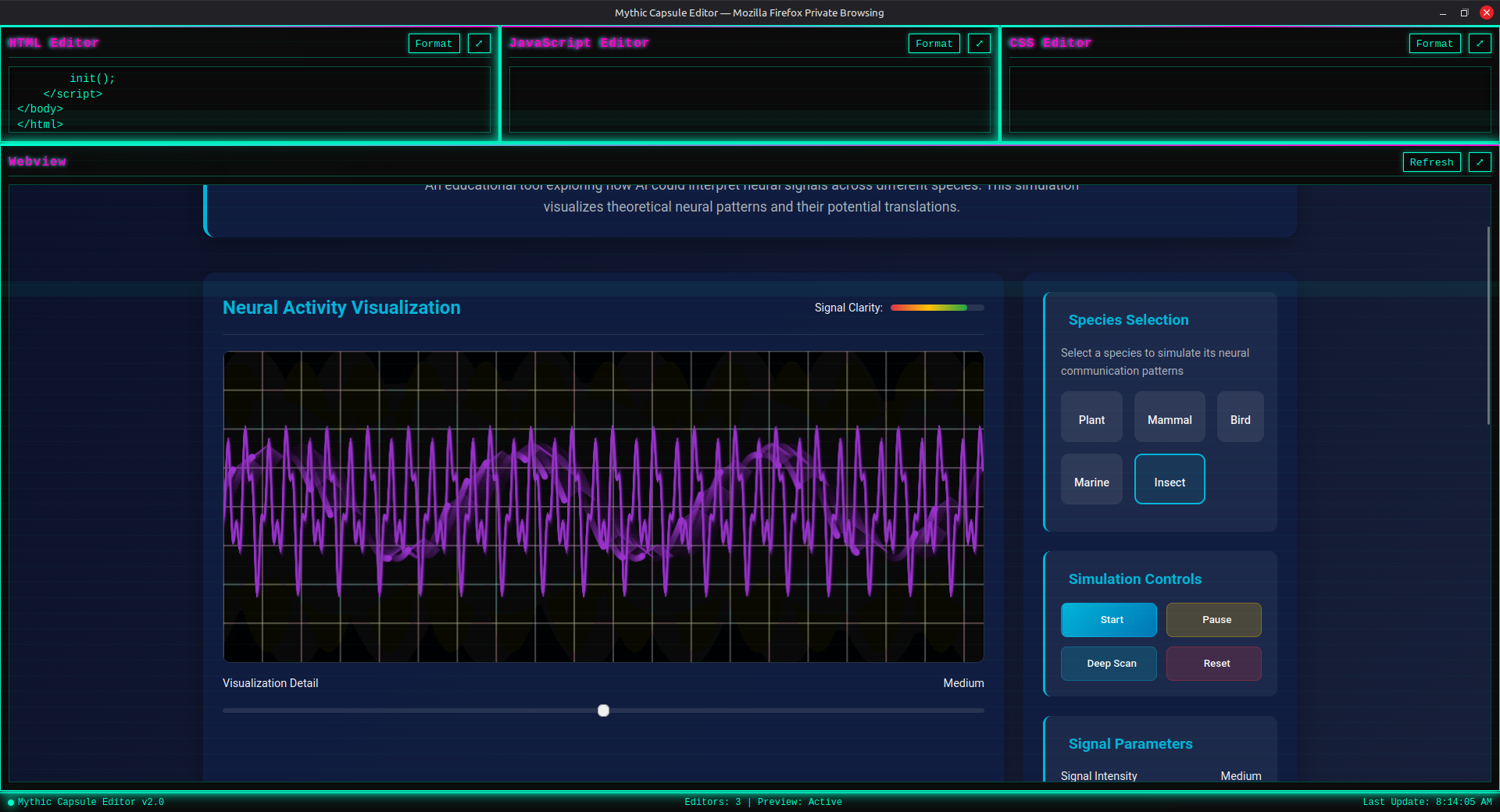
Key Educational Features

Scientific Visualization
  • ✓ Real-time neural pattern visualization for different species
  • ✓ AI translation simulation for neural signal interpretation
  • ✓ Interactive learning with hands-on exploration
  • ✓ Species-specific neural characteristics display
Interactive Controls
  • ✓ Adjustable signal intensity and complexity parameters
  • ✓ Visualization detail control for different learning levels
  • ✓ Real-time pattern generation and analysis
  • ✓ Cross-species comparison tools

Species-Specific Neural Patterns

Plant Communication
Slow electrical pulses & chemical diffusion
Mammalian Neural Patterns
Rapid spike trains & cortical oscillations
Avian Signals
High-frequency neural bursts for navigation
Marine Bioacoustics
Echolocation & electroreception patterns
Insect Swarm Intelligence
Compound eye processing & pheromone tracking

AI Translation Capabilities

Pattern Recognition
  • ✓ Neural signal pattern detection across species
  • ✓ Frequency and amplitude analysis algorithms
  • ✓ Temporal pattern correlation matching
  • ✓ Signal-to-noise ratio optimization
Translation Algorithms
  • ✓ Cross-species neural encoding/decoding
  • ✓ Pattern similarity mapping across taxa
  • ✓ Context-aware signal interpretation
  • ✓ Adaptive learning from signal databases

Educational Content Modules

Plant Neural Biology
Electrical signaling in plant communication systems
Mammalian Cortex
Cortical column organization and signal processing
Avian Navigation
Neural mechanisms for magnetic field detection
Marine Acoustics
Underwater sound propagation and detection

Learning Objectives

Neural Communication
  • ✓ Understand different neural communication mechanisms across species
  • ✓ Compare signal characteristics between different life forms
  • ✓ Recognize pattern variations based on biological complexity
AI Applications
  • ✓ Explore how AI pattern recognition could interpret biological signals
  • ✓ Learn about scientific methods in neural signal analysis
  • ✓ Understand AI translation potential for interspecies communication

Simulation Parameters

Signal Intensity
Adjusts neural signal amplitude and strength
Pattern Complexity
Controls signal intricacy and detail level
Visualization Detail
Sets rendering resolution and clarity
Translation Accuracy
Simulates AI interpretation confidence levels

Technical Implementation

Browser-Based Simulation
  • ✓ Runs completely in modern web browsers
  • ✓ No external dependencies or plugins required
  • ✓ Works offline after initial loading
  • ✓ Suitable for educational settings with varying internet access
Educational Accessibility
  • ✓ Adjustable difficulty levels for different age groups
  • ✓ Support for assistive technologies and screen readers
  • ✓ Multilingual interface options available
  • ✓ Printable educational materials and guides
AI NEURAL PATTERN TRANSLATION SIMULATOR ACTIVE
Exploring cross-species neural communication through AI pattern recognition
Status: EDUCATIONAL MODE · Species: 5 Categories · Visualization: REAL-TIME · Accessibility: BROWSER-BASED
🔬
SCIENTIFIC BASIS
The simulation is based on published research in neurobiology, animal communication, and AI pattern recognition. While true interspecies neural communication translation remains speculative, this simulation demonstrates how AI could potentially bridge communication gaps by recognizing and interpreting patterned biological signals across different taxa. All visualizations are based on actual neural signal characteristics observed in scientific studies.

AI Lab Simulation Generator

The AI Lab Simulation Generator provides an interactive educational environment for exploring machine learning concepts through real-time visualizations. This simulation allows users to experiment with different AI models, adjust parameters, and observe learning processes with immediate visual feedback.
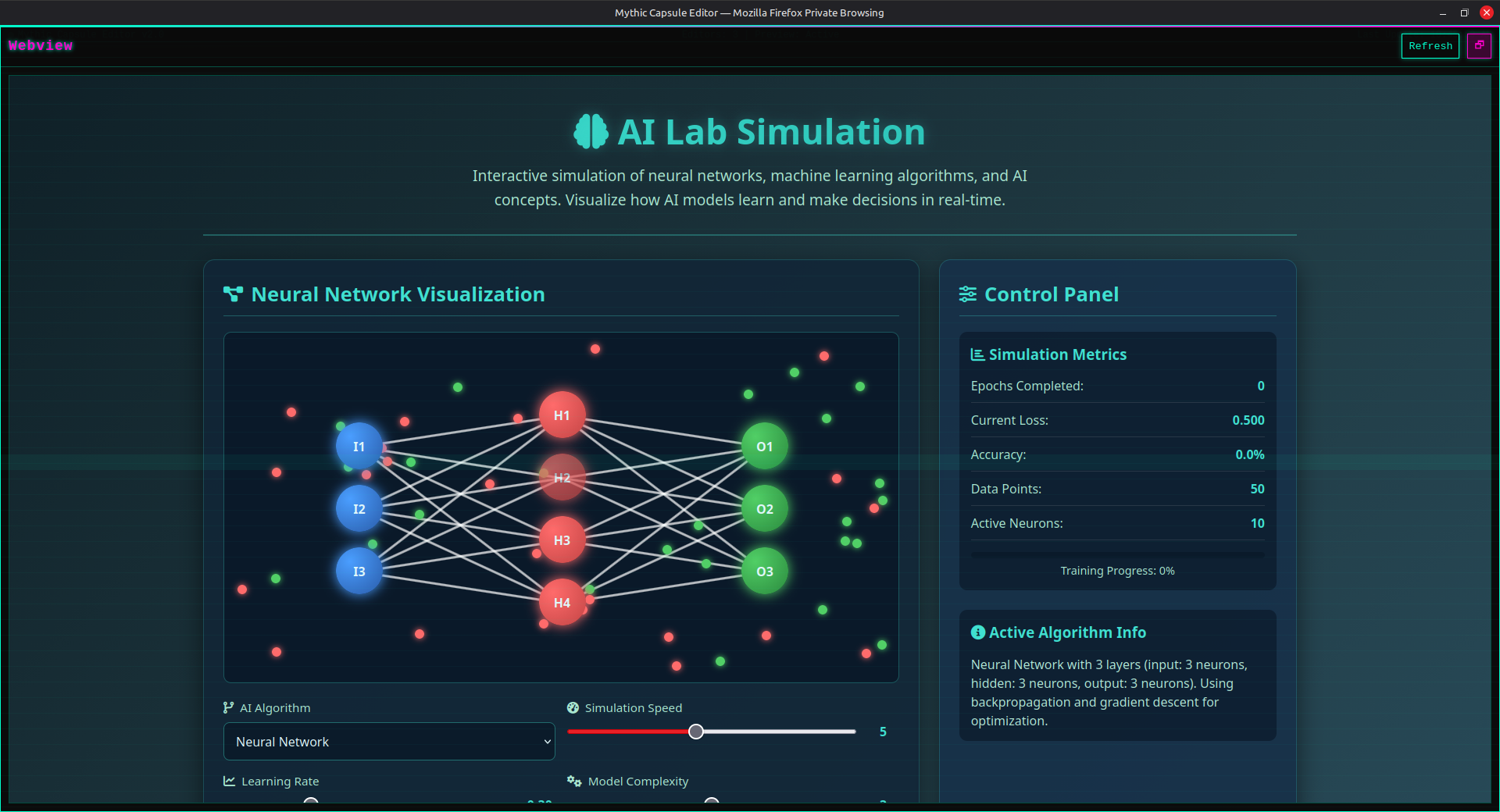
Interactive Visualizations

Neural Networks
  • ✓ Multi-layer perceptron with animated node connections
  • ✓ Real-time activation visualization across layers
  • ✓ Gradient flow and weight adjustment animations
  • ✓ Interactive neuron activation tracking
Clustering & Classification
  • ✓ K-Means clustering with dynamic centroid movement
  • ✓ Decision boundary visualization for classification
  • ✓ Cluster formation and reassignment animations
  • ✓ Interactive data point manipulation
Regression Analysis
  • ✓ Linear regression with error line visualization
  • ✓ Real-time line fitting adjustments
  • ✓ Residual error calculation and display
  • ✓ Multiple regression model comparisons
Model Training
  • ✓ Epoch-by-epoch training progression
  • ✓ Loss function convergence visualization
  • ✓ Accuracy improvement tracking
  • ✓ Overfitting/underfitting detection indicators

Real-Time Controls & Parameters

Adjustable Learning Rate Simulation Speed Control Model Complexity Settings Start/Pause/Reset Functionality Interactive Data Point Manipulation Manual Training Step Control

Live Training Metrics

Training Epochs
Real-time counter of training iterations
Loss Function
Visualization of error minimization over time
Accuracy Percentage
Model performance tracking in real-time
Active Neurons
Real-time display of neural network activity

Supported AI Models

Neural Network
Multi-layer perceptron
K-Means Clustering
Unsupervised learning
Linear Regression
Predictive modeling
Decision Boundaries
Classification visualization

Educational Features

Algorithm Information
  • ✓ Detailed explanation panels for each algorithm
  • ✓ Mathematical foundations and theory overview
  • ✓ Real-world applications and use cases
  • ✓ Step-by-step learning guides
Visual Feedback
  • ✓ Color-coded activation levels in neural networks
  • ✓ Animation of training convergence processes
  • ✓ Error highlighting and correction visualization
  • ✓ Progress indicators for all training phases
Interactive Learning
  • ✓ Drag-and-drop data point creation
  • ✓ Real-time parameter adjustment effects
  • ✓ Comparative analysis between different models
  • ✓ Experimentation with different datasets
Realistic Simulation
  • ✓ Accurate mathematical modeling
  • ✓ Real-world noise and variability simulation
  • ✓ Progressive difficulty levels
  • ✓ Benchmark comparison capabilities

How to Use the Simulation

1
Select AI Algorithm
Choose from dropdown menu
2
Adjust Parameters
Use sliders for fine-tuning
3
Start Training
Click "Start Training" button
4
Observe & Analyze
Watch real-time learning
5
Experiment & Reset
Try different settings

Learning Outcomes

Understand neural network architecture Grasp clustering algorithms visually Learn regression analysis fundamentals Master parameter tuning effects Visualize decision boundaries Develop intuition for AI training

Technical Implementation

Visualization Engine
HTML5 Canvas with WebGL acceleration
Algorithm Core
Pure JavaScript implementation
Performance
60 FPS real-time rendering
Compatibility
Works on all modern browsers
AI LAB SIMULATION GENERATOR · INTERACTIVE LEARNING ACTIVE
Real-time AI model visualization · Multiple algorithm support · Educational feedback · Parameter experimentation
Status: EDUCATIONAL MODE · Models: 4 Algorithms · Visualization: REAL-TIME · Controls: INTERACTIVE
🎓
EDUCATIONAL VALUE
This simulation provides hands-on learning experience for understanding fundamental AI and machine learning concepts. By visualizing abstract mathematical processes in real-time, users develop intuition for how algorithms work, how parameters affect outcomes, and how different models approach problem-solving. The interactive nature allows for experimentation without requiring programming knowledge, making it accessible to students, educators, and anyone interested in understanding AI fundamentals.

Organic-Photonic Hybrid AI System

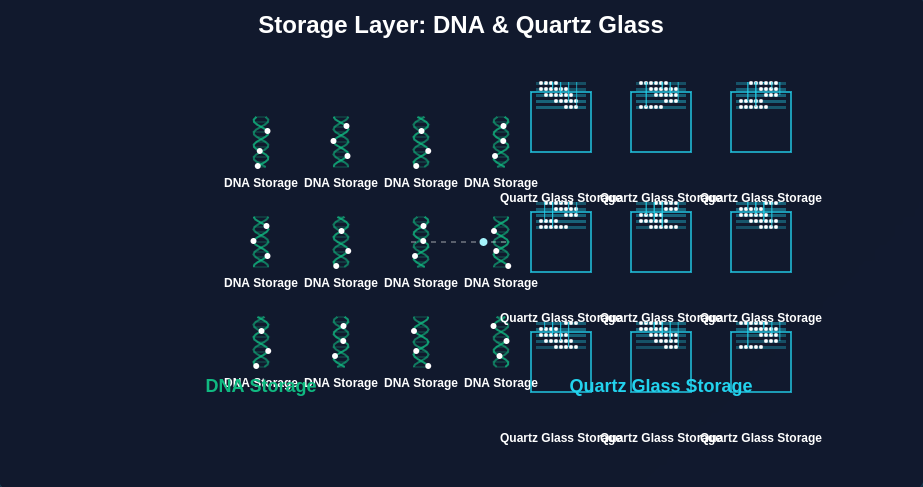
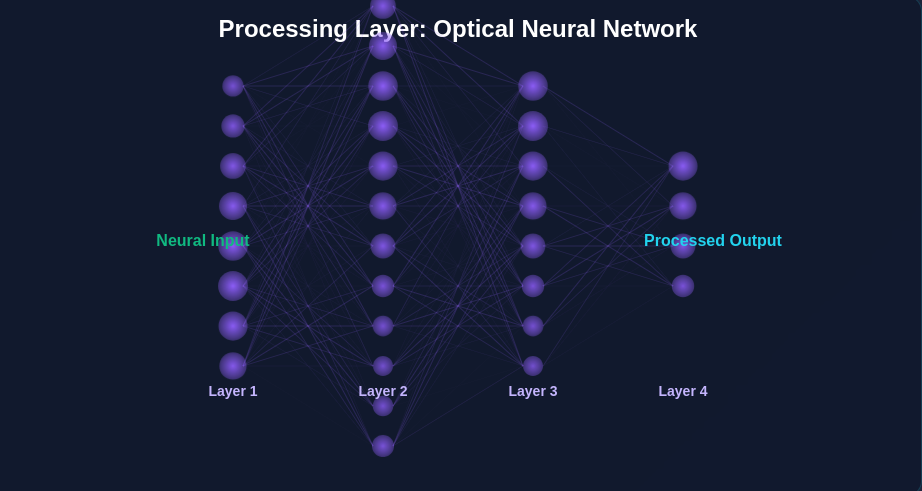
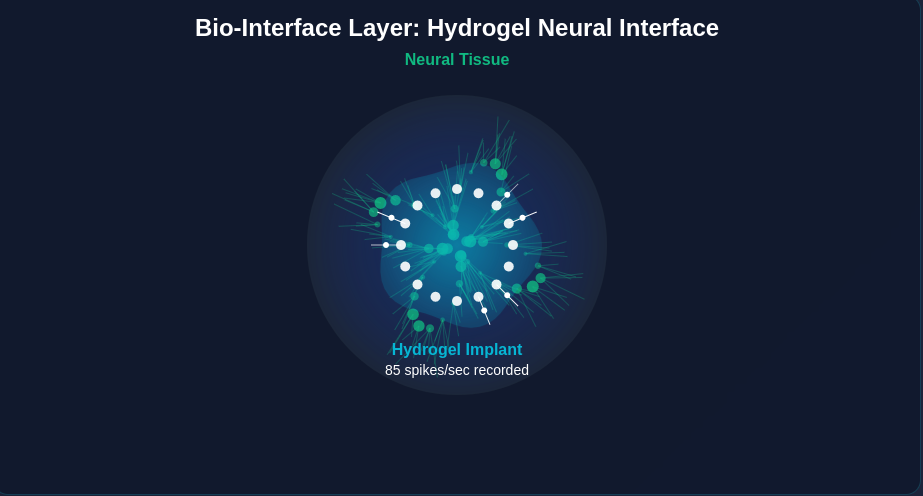
The Organic-Photonic Hybrid AI System represents the next evolution in biocomputing — a fusion of biological storage, photonic processing, and neural interfaces. This simulation visualizes a complete system that stores data in DNA and quartz glass, processes information through optical neural networks, and interfaces with biological systems via hydrogel implants.

SIMULATION ACTIVE · Real-time visualization of organic-photonic hybrid system with interactive controls
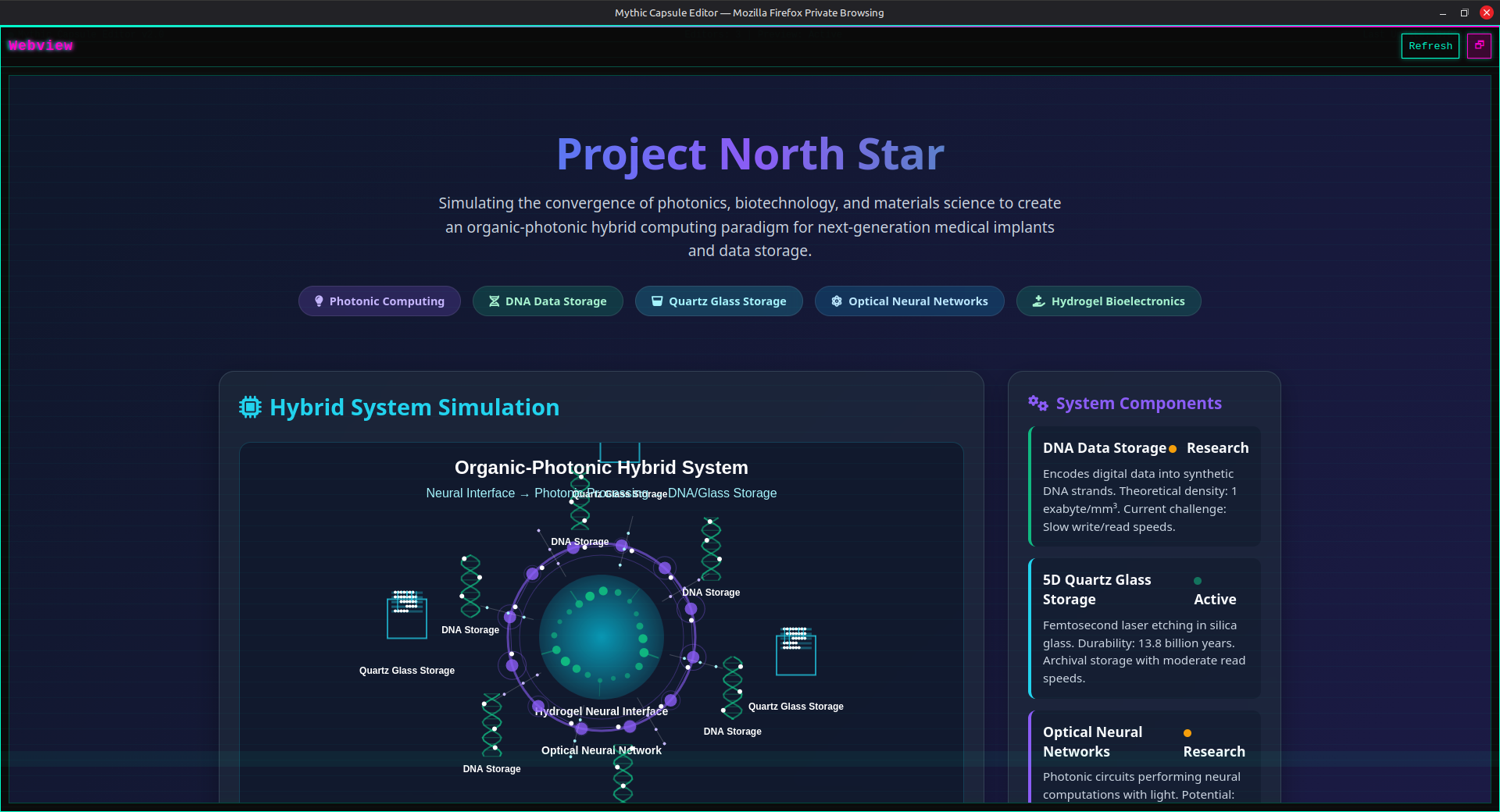
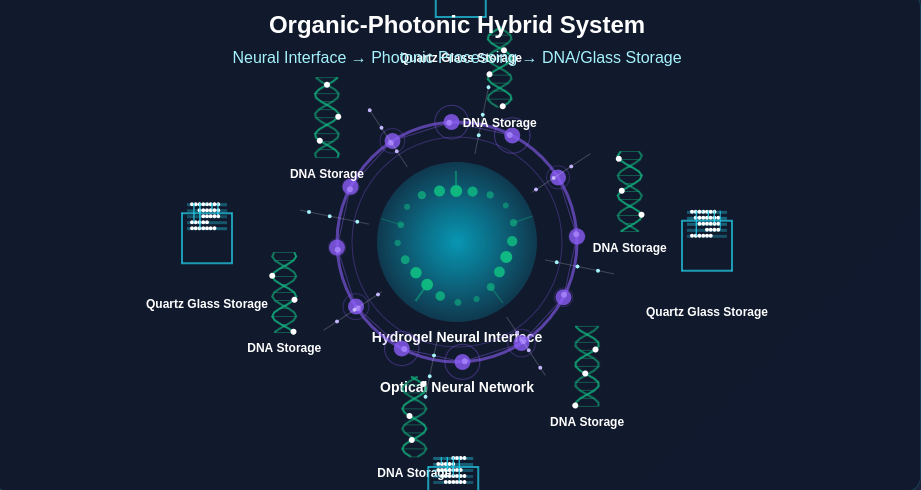
Interactive Simulation Features

Interactive Simulation Canvas
  • ✓ Real-time visualization of organic-photonic hybrid system
  • ✓ Dynamic component animations and data flows
  • ✓ Interactive zoom and pan capabilities
  • ✓ Multiple visualization detail levels
Multiple View Modes
  • ✓ Full System View - All components integrated
  • ✓ Storage Layer - DNA & quartz glass visualization
  • ✓ Processing Layer - Optical neural network animation
  • ✓ Bio-Interface Layer - Hydrogel implant simulation

Live Data Display & Metrics

Neural Signal Processing: 4.2TB/s Photonic Computation: 150PetaFLOPS DNA Write Speed: 12GB/day Glass Read Speed: 280GB/s System Efficiency: 94.7%

Interactive Controls

Start/Pause/Reset
Full simulation control
Simulation Speed
Adjustable from 0.5x to 10x
Data Density
Control parameter adjustment
View Switching
Toggle between different layers

Technical Information Panel

Component Details
  • ✓ Detailed descriptions of each system component
  • ✓ Technical specifications and capabilities
  • ✓ Integration architecture and protocols
  • ✓ Performance benchmarks and metrics
Development Timeline
  • ✓ Convergence roadmap 2025-2050+
  • ✓ Current research status indicators
  • ✓ Milestone tracking and progress
  • ✓ Future development projections

Visual Effects & Animations

DNA Double Helix
Animated helix with flowing data particles
Photonic Circuits
Pulsing circuits with light transmission
Glass Storage
Laser reading animations and data access
Hydrogel Interface
Neural signal recording and processing

Real-Time Data Flow Visualization

Data Acquisition
Real-time neural signal capture
Storage Processing
DNA encoding and glass writing
Computation Flow
Photonic neural network processing
Output Generation
Bio-interface response generation

System Architecture

Storage Subsystem
  • ✓ DNA Storage - Archival, ultra-dense (1EB/gram)
  • ✓ Quartz Glass - Fast access, radiation-resistant
  • ✓ Hybrid Controller - Intelligent data allocation
  • ✓ Error Correction - Quantum-resistant encoding
Processing Subsystem
  • ✓ Optical Neural Network - Light-speed computation
  • ✓ Photonic Circuits - Low energy, high bandwidth
  • ✓ Quantum Co-processor - Specialized calculations
  • ✓ Adaptive Learning - Real-time optimization
Bio-Interface Subsystem
  • ✓ Hydrogel Implant - Biocompatible neural interface
  • ✓ Signal Processing - Real-time neural decoding
  • ✓ Feedback Systems - Two-way communication
  • ✓ Safety Protocols - Fail-safe mechanisms

Convergence Timeline (2025-2050+)

2025-2028
Component Development
Individual subsystems prototyping
2029-2035
Integration Phase
System integration and testing
2036-2045
Refinement & Scaling
Performance optimization
2046-2050+
Mass Implementation
Widespread deployment

Responsive Design Features

Adaptive Canvas Sizing Touch Gesture Support Mobile-Optimized Controls Cross-Browser Compatibility Performance Optimization Accessibility Features
ORGANIC-PHOTONIC HYBRID AI SYSTEM SIMULATION ACTIVE
Interactive visualization of DNA+Glass storage · Optical neural networks · Bio-interface convergence
Status: SIMULATION ACTIVE · Views: 5 Layers · Metrics: REAL-TIME · Controls: INTERACTIVE
🧬
SCIENTIFIC SIGNIFICANCE
This simulation represents the convergence of three transformative technologies: biological storage (DNA for ultra-dense archival), photonic computing (light-speed processing with minimal energy), and neural interfaces (direct brain-computer communication). The hybrid approach addresses fundamental limitations in traditional computing while opening new possibilities for human-AI integration, medical applications, and long-term data preservation. Each component is based on current research frontiers in their respective fields.

Helium‑3 Synthetic Creation Simulation

The Helium‑3 Synthetic Creation Simulation provides an interactive visualization of nuclear fusion reactions to produce Helium‑3, a valuable isotope with applications in nuclear fusion, medical imaging, and space exploration. This simulation allows real‑time manipulation of reaction parameters and visualizes the nuclear physics behind isotope synthesis.

SIMULATION ACTIVE · Real-time nuclear fusion visualization with interactive reaction controls
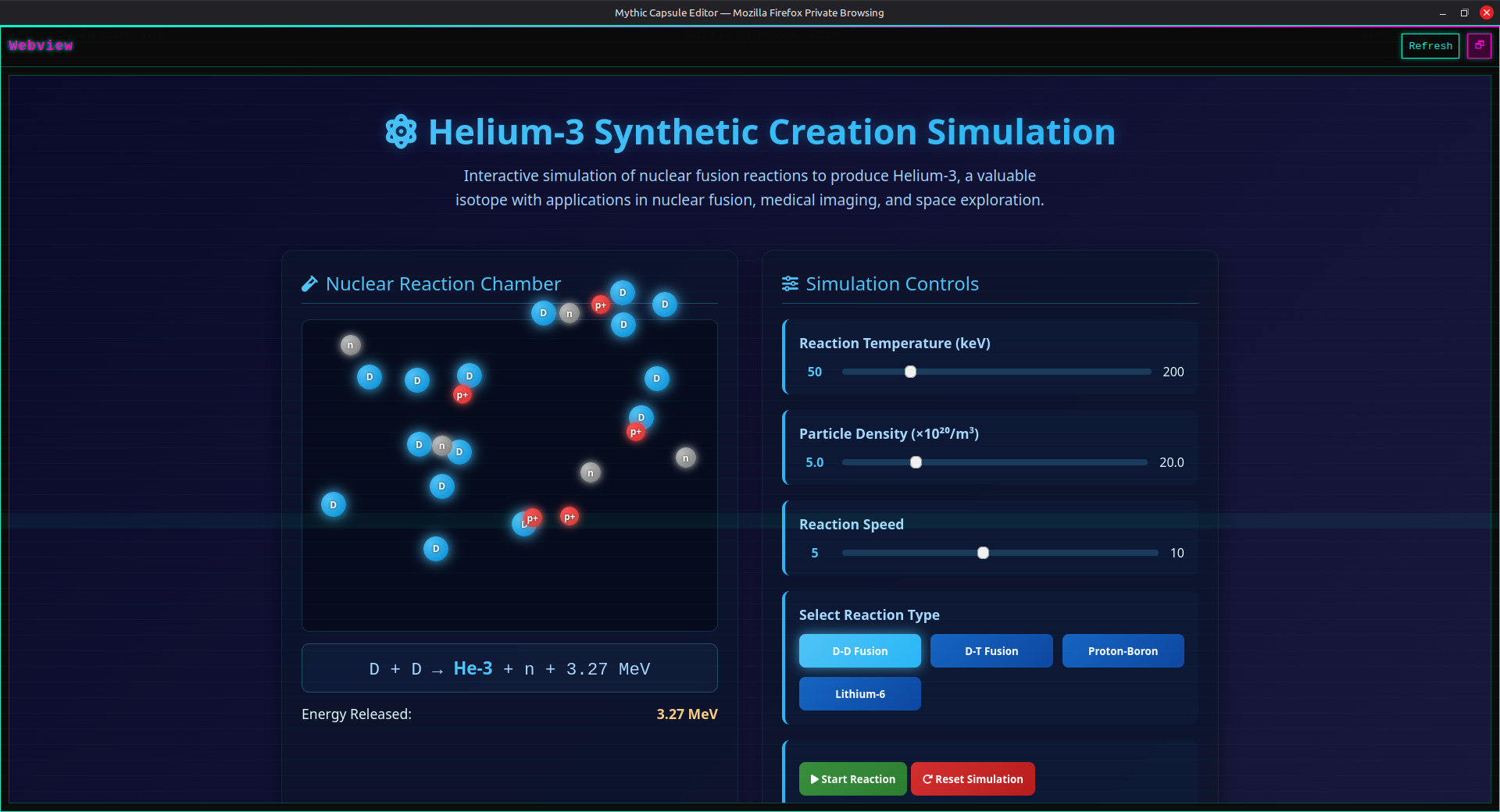
Nuclear Reaction Chamber

Particle Visualization
  • ✓ Deuterium nuclei (D) with proton-neutron pairs
  • ✓ Real‑time particle interactions and collisions
  • ✓ Fusion reaction animation and visualization
  • ✓ Helium‑3 formation and neutron emission
Reaction Dynamics
  • ✓ D + D → He‑3 + n + 3.27 MeV reaction
  • ✓ Energy release calculation and display
  • ✓ Particle trajectory and velocity visualization
  • ✓ Reaction success/failure rate tracking

Simulation Controls

Reaction Temperature
50–200 keV range control
Particle Density
5.0–20.0 ×10²⁰/m³ adjustment
Reaction Speed
5–10 scale simulation speed

About Helium‑3 Production

What is Helium‑3?

Helium‑3 (³He) is a light, non‑radioactive isotope of helium with two protons and one neutron. It's extremely rare on Earth but abundant on the Moon's surface, deposited by solar winds over billions of years.

Synthetic Production

Helium‑3 can be produced artificially through nuclear fusion reactions, primarily by fusing deuterium (D) nuclei or through the decay of tritium (T). The D‑D reaction pathway is shown in this simulation.

Applications of Helium‑3

Nuclear Fusion Fuel
Aneutronic fusion with minimal radiation
Medical Imaging
Lung MRI and respiratory diagnostics
Neutron Detection
Radiation monitoring and security
Cryogenics
Ultra‑low temperature refrigeration
Space Exploration
Potential lunar mining resource

Simulation Details

Nuclear Reaction Equation
D + D → He‑3 + n + 3.27 MeV
This simulation demonstrates deuterium‑deuterium (D‑D) fusion, where two deuterium nuclei fuse to form Helium‑3 and a neutron with an energy release of 3.27 MeV. The reaction requires high temperatures (50‑200 keV) to overcome Coulomb repulsion between positively charged nuclei.

Interactive Features

Parameter Controls
  • ✓ Real‑time temperature adjustment (keV)
  • ✓ Particle density control (×10²⁰/m³)
  • ✓ Reaction speed modulation
  • ✓ Reaction type selection (D‑D, D‑T)
Visual Feedback
  • ✓ Particle interaction animations
  • ✓ Energy release visualization
  • ✓ Reaction success rate indicator
  • ✓ Real‑time metrics and statistics

Technical Parameters

3.27 MeV
Energy per Reaction
50–200 keV
Temperature Range
0.014%
Natural Abundance
5.0×10²⁰
Optimal Density

Nuclear Reaction Types

D‑D Primary
D + D → He‑3 + n (3.27 MeV)
D‑D Secondary
D + D → T + p (4.03 MeV)
D‑T Fusion
D + T → He‑4 + n (17.6 MeV)
T‑T Fusion
T + T → He‑4 + 2n (11.3 MeV)

Educational Value

Nuclear Physics
  • ✓ Understand nuclear fusion fundamentals
  • ✓ Learn about Coulomb barrier and temperature requirements
  • ✓ Study reaction cross‑sections and probabilities
  • ✓ Explore isotope production methods
Energy Applications
  • ✓ Compare fusion reaction energy yields
  • ✓ Understand aneutronic fusion advantages
  • ✓ Study potential fusion reactor fuels
  • ✓ Analyze energy production scalability
HELIUM‑3 SYNTHETIC CREATION SIMULATION ACTIVE
Interactive nuclear fusion visualization · Real‑time reaction controls · Educational physics simulation
Status: SIMULATION ACTIVE · Reaction: D‑D Fusion · Energy: 3.27 MeV/reaction · Controls: INTERACTIVE
⚛️
SCIENTIFIC SIGNIFICANCE
Helium‑3 represents a potential solution to multiple technological challenges. As a fusion fuel, it offers the possibility of aneutronic reactions that produce minimal radioactive waste. In medicine, its unique spin‑1/2 nucleus enables advanced MRI techniques. The simulation demonstrates the physics behind producing this valuable isotope artificially, as natural sources are extremely limited on Earth but potentially abundant on lunar regolith, making it a target for future space resource utilization.

Project Jellyfish

Project Jellyfish explores the theoretical integration of Turritopsis dohrnii (immortal jellyfish) DNA into human cellular systems to unlock regenerative capabilities and longevity enhancement. This simulation models DNA compatibility, transdifferentiation processes, and potential risks associated with cross-species genetic integration.

ETHICAL SIMULATION ACTIVE · Theoretical exploration only · Significant biological challenges exist
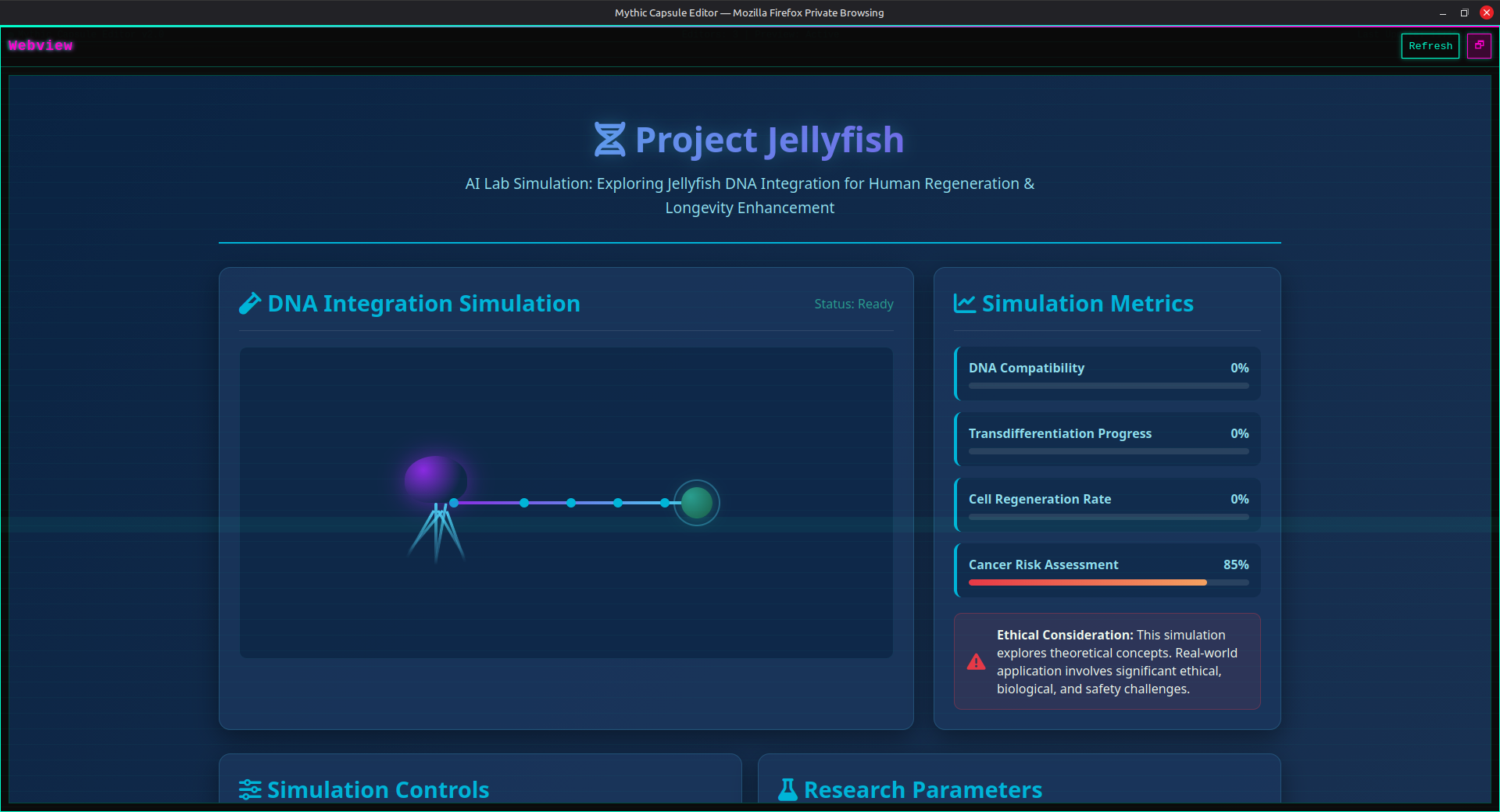
Simulation Overview

Research Focus
  • ✓ Turritopsis dohrnii DNA sequence analysis
  • ✓ Cellular transdifferentiation mechanisms
  • ✓ Human-jellyfish genetic compatibility modeling
  • ✓ Regenerative medicine potential assessment
Simulation Status
Ready for Simulation
AI Lab Simulation: Exploring Jellyfish DNA Integration for Human Regeneration & Longevity Enhancement

Simulation Metrics Dashboard

DNA Compatibility
0%
Initial State
Transdifferentiation Progress
0%
Cellular reprogramming
Cell Regeneration Rate
0%
Tissue repair acceleration
Cancer Risk Assessment
85%
CRITICAL
⚠️
ETHICAL CONSIDERATION
This simulation explores theoretical concepts. Real-world application involves significant ethical, biological, and safety challenges. Cross-species genetic integration presents major risks including immune rejection, cancer development, and unforeseen biological consequences.

Simulation Controls

Jellyfish DNA Integration Level 0%
Cellular Reprogramming Intensity 0%

Research Parameters

AI Confidence Level
0%
Simulation accuracy estimate
Evolutionary Distance
600M+ years
Genetic divergence timeline
Projected Lifespan Increase
0%
Theoretical maximum benefit
Tissue Repair Acceleration
0%
Wound healing enhancement
Immune Response Risk
95%
EXTREME
Genetic Stability
15%
LOW

Simulation Log

[00:00:00] System initialized. Project Jellyfish simulation ready.
[00:00:00] Turritopsis dohrnii DNA sequence loaded.
[00:00:00] Human fibroblast cell model initialized.
[00:00:00] Warning: Evolutionary distance detected (600M+ years).
[00:00:00] High cancer risk identified (85%). Proceed with caution.
[11:15:21] System initialized. Project Jellyfish simulation ready.
[11:15:21] Turritopsis dohrnii DNA sequence loaded.
[11:15:21] Human fibroblast cell model initialized.
[11:15:21] Warning: Evolutionary distance detected (600M+ years).
[11:15:21] High cancer risk identified (85%). Proceed with caution.

Scientific Basis

Turritopsis Dohrnii
  • ✓ Known as "immortal jellyfish"
  • ✓ Capable of cellular transdifferentiation
  • ✓ Can revert to younger life stages
  • ✓ Unique genetic pathways for regeneration
Research Challenges
  • ✓ 600+ million years of evolutionary divergence
  • ✓ Fundamental differences in cellular biology
  • ✓ Immune system compatibility issues
  • ✓ Cancer risk from uncontrolled cell growth

Potential Applications

Organ Regeneration
Theoretical tissue repair acceleration
Age-Related Disease Prevention
Cellular rejuvenation pathways
Wound Healing Enhancement
Rapid tissue regeneration
Neurodegenerative Conditions
Nerve cell regeneration

Ethical Framework

Primary Concerns
  • ✓ Unintended biological consequences
  • ✓ Cancer development risk (85%+)
  • ✓ Immune system rejection (95%+)
  • ✓ Genetic stability issues (15%)
Regulatory Considerations
  • ✓ Cross-species genetic modification
  • ✓ Human germline editing implications
  • ✓ Bioethics committee approval required
  • ✓ International regulatory compliance
PROJECT JELLYFISH · THEORETICAL SIMULATION ACTIVE
Exploring Turritopsis dohrnii DNA integration for human regeneration · High-risk theoretical research
Status: SIMULATION READY · Cancer Risk: 85% · Evolutionary Distance: 600M+ years · Ethics: CRITICAL
🧬
SCIENTIFIC CONTEXT
Turritopsis dohrnii represents one of the few known biologically immortal animals, capable of reverting its cells to a younger state through transdifferentiation. While this process holds theoretical promise for regenerative medicine, the vast evolutionary distance (600+ million years) and fundamental differences in cellular biology present enormous challenges. This simulation highlights both the potential benefits and significant risks of cross-species genetic integration, emphasizing the need for extensive safety research and ethical consideration before any real-world application could be considered.

Hemi‑Sync Consciousness Simulation

The Hemi‑Sync Consciousness Simulation explores the use of binaural beat technology for brainwave entrainment and consciousness exploration. Based on the Monroe Institute's research, this simulation visualizes how specific audio frequencies can synchronize brain hemispheres and facilitate altered states of awareness for meditation, learning, and expanded consciousness.

SIMULATION ACTIVE · Real-time brainwave synchronization visualization with interactive frequency controls
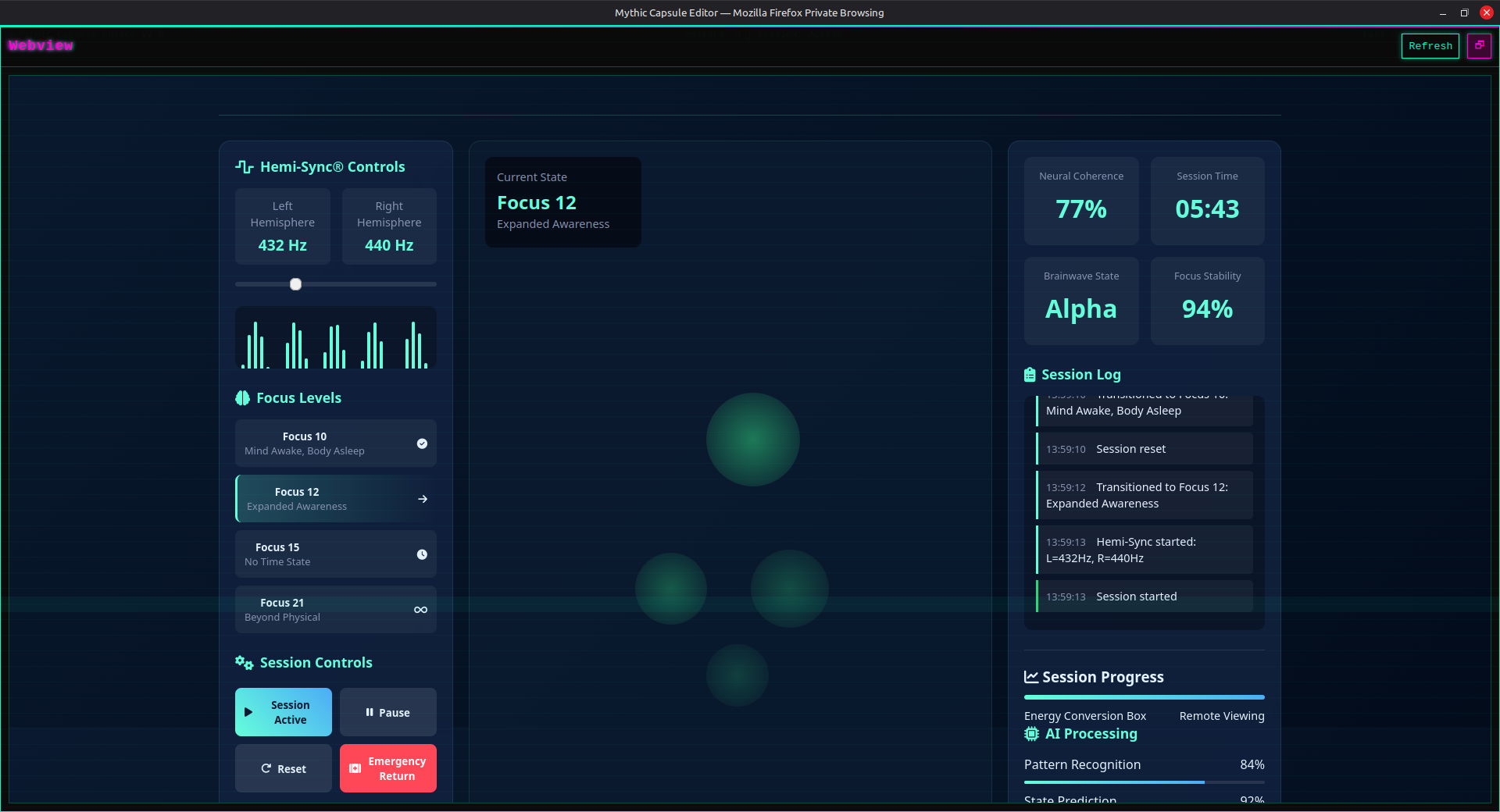
Simulation Interface Overview

Brainwave Visualization
  • ✓ Real-time EEG pattern display with bilateral symmetry
  • ✓ Left/right hemisphere activity comparison
  • ✓ Brainwave frequency spectrum analysis (Beta, Alpha, Theta, Delta)
  • ✓ Coherence and synchronization indicators
Audio Control Panel
  • ✓ Carrier frequency adjustment (100-400 Hz)
  • ✓ Beat frequency modulation (0.5-30 Hz)
  • ✓ Volume and balance controls
  • ✓ Audio waveform visualization

Consciousness State Tracking

Beta (13-30 Hz)
Awake, alert, active mind
Cognitive processing
Alpha (8-13 Hz)
Relaxed, reflective, calm
Meditation, creativity
Theta (4-8 Hz)
Dreaming, deep meditation
Intuition, memory
Delta (0.5-4 Hz)
Deep sleep, healing
Restoration, growth

Hemi‑Sync Technology Overview

What is Hemi‑Sync?

Hemi‑Sync® (Hemispheric Synchronization) is a patented audio technology developed by The Monroe Institute that uses binaural beats to synchronize brainwave activity between the left and right cerebral hemispheres, facilitating altered states of consciousness for meditation, learning, and personal growth.

How Binaural Beats Work

When slightly different frequencies are presented to each ear (e.g., 200 Hz in left ear, 208 Hz in right ear), the brain perceives a third frequency (8 Hz) – the binaural beat. This stimulates brainwave entrainment, synchronizing neural activity to the beat frequency.

Interactive Simulation Controls

Carrier Frequency
100–400 Hz base frequency control
Beat Frequency
0.5–30 Hz binaural beat modulation
Volume Balance
Left/right ear volume adjustment
Session Duration
5–60 minute session timer

Real-Time Brainwave Metrics

13-30
Beta (Hz)
8-13
Alpha (Hz)
4-8
Theta (Hz)
0.5-4
Delta (Hz)

Applications & Benefits

Meditation Enhancement
Deeper, more focused meditation states
Stress Reduction
Anxiety relief and relaxation
Sleep Improvement
Insomnia treatment and deep sleep
Focus & Learning
Enhanced concentration and memory
Creativity Boost
Access to creative flow states
Pain Management
Chronic pain reduction techniques

Scientific Research Basis

Research Foundation
The Monroe Institute conducted decades of research into consciousness states using Hemi‑Sync® technology. Studies suggest binaural beats can influence brainwave patterns, potentially affecting:
✓ EEG Pattern Changes
Measurable shifts in brainwave frequencies
✓ Hemispheric Synchronization
Increased coherence between brain hemispheres
✓ Subjective Experience
Reported changes in consciousness states
✓ Physiological Effects
Changes in heart rate, breathing, relaxation

Simulation Features

Visual Feedback
  • ✓ Real-time brainwave pattern visualization
  • ✓ Left/right hemisphere activity comparison
  • ✓ Frequency spectrum waterfall display
  • ✓ Coherence and synchronization indicators
Audio Simulation
  • ✓ Synthesized binaural beat generation
  • ✓ Pink noise background for realism
  • ✓ Adjustable carrier and beat frequencies
  • ✓ Stereo panning and balance controls
Session Management
  • ✓ Pre-programmed frequency protocols
  • ✓ Customizable session durations
  • ✓ Progress tracking and session history
  • ✓ Exportable session data
Educational Content
  • ✓ Brainwave science explanations
  • ✓ Hemi‑Sync history and research
  • ✓ Consciousness state descriptions
  • ✓ Safety guidelines and best practices

Safety & Guidelines

Epilepsy Warning
Flashing visuals may trigger seizures
Medical Conditions
Consult doctor if you have medical issues
Volume Safety
Use moderate volume to protect hearing
Environment
Use in safe, comfortable settings
HEMI‑SYNC CONSCIOUSNESS SIMULATION ACTIVE
Exploring brainwave entrainment · Binaural beat technology · Consciousness state visualization
Status: SIMULATION ACTIVE · Frequencies: 4 Brainwave Bands · Controls: INTERACTIVE · Safety: GUIDELINES ACTIVE
🧠
SCIENTIFIC CONTEXT
Hemi‑Sync® technology represents decades of research into consciousness and brainwave activity. While binaural beats are a well-documented auditory phenomenon, their effects on consciousness remain an area of ongoing scientific inquiry. This simulation demonstrates the basic principles of how different frequency combinations might influence brainwave patterns, based on the research conducted by The Monroe Institute and subsequent studies in neuroacoustics. Individual responses can vary significantly based on personal physiology, mindset, and environment.

Starship Life Support Simulation

The Starship Life Support Simulation models a comprehensive three-layer architecture for sustaining human life during interstellar journeys spanning decades or centuries. This system integrates targeted temperature management, fluid-based rehabilitation, and biological support systems to address both physiological and psychological challenges of deep space travel.

SIMULATION ACTIVE · Three-layer human sustainability architecture · Real-time system monitoring
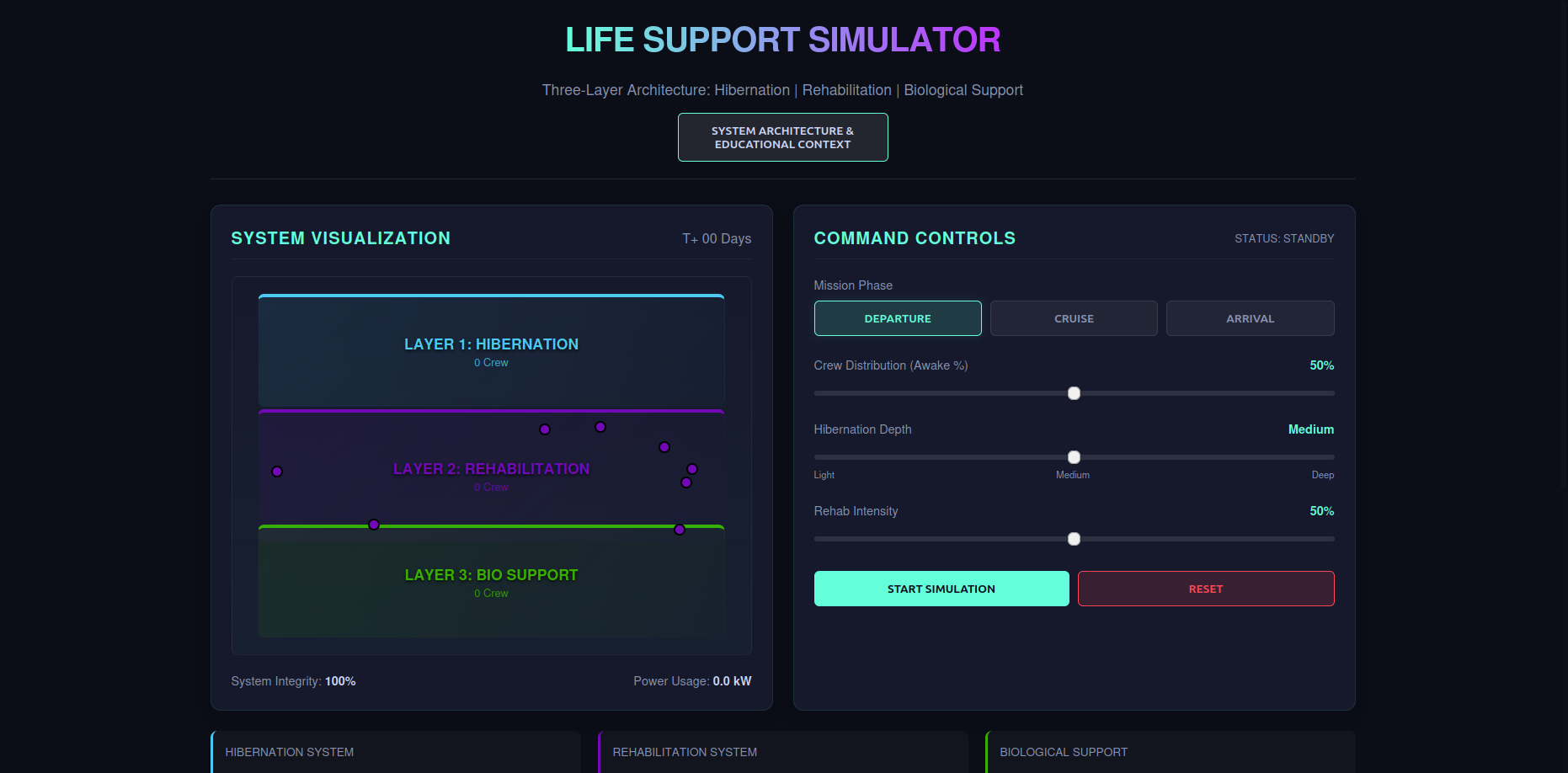
Simulation Educational Context

The Three-Layer Architecture
Based on comprehensive multi-AI analysis and scientific extrapolation, this simulator models a comprehensive starship life support strategy. Rather than relying on a single "magic bullet" technology (like cryogenics alone), this architecture uses interdependent systems to manage human physiology and psychology over interstellar timescales.
⚠️
Clarifying Scientific Misconceptions
Early AI concepts hallucinated substances like "Melanon" or suggested fatal temperatures (70-80°C). This simulation corrects these errors to reflect realistic biological constraints:
  • No "Melanon": No known substance allows consciousness at cryogenic temperatures.
  • Temperature Reality: 70°C is fatal. This simulation uses safe metabolic suppression ranges (32-37°C).
  • Saline vs. Cryo: Saline tanks are for rehabilitation (body temp), not freezing (-100°C).

Layer 1: Primary Hibernation System

Technology & Mechanism
  • Targeted Temperature Management (TTM) with Pharmacological Torpor
  • ✓ Induces mild hypothermia (32-34°C) combined with metabolic suppression drugs
  • ✓ Achieves ~90% metabolic reduction during cruise phase
  • ✓ Reduces psychological strain and resource consumption
Simulation Controls
Use the "Hibernation Depth" slider to balance power savings against wake-up recovery time. Deeper hibernation saves more resources but requires longer rehabilitation periods.
Current Status
Hibernation Active · 87% Metabolic Reduction

Layer 2: Fluid-Based Rehabilitation (FTUs)

Technology & Environment
  • Advanced Floatation Therapy Units (FTUs)
  • ✓ Epsom salt-saturated water (density ~1.25 g/cm³) at 34-35°C
  • ✓ Low-gravity fluid environment for muscle preservation
  • ✓ Sensory reduction and mental health maintenance
Primary Functions
  • Pre-Hibernation: 48-hour sensory reduction preparation
  • Post-Hibernation: Graduated muscle reactivation protocols
  • Mental Health: Quarterly "reset" sessions for awake crew
  • ✓ Prevention of sensory deprivation psychosis
Simulation Relevance: The "Rehab Intensity" slider controls how many resources are dedicated to keeping the awake crew physically and mentally fit. Higher intensity means faster recovery but greater resource consumption.

Layer 3: Biological Support (CECs)

Technology & Purpose
  • Controlled Environment Chambers (CECs)
  • ✓ Hydroponic plant cultures for oxygen replenishment
  • ✓ Tissue samples and experimental organisms
  • ✓ Food sustainability and biological diversity maintenance
System Integration
CECs connect directly to the ship's main life support systems, providing:
Oxygen Generation:
Active · 78% Efficiency
Food Production:
65% Self-Sufficient
Waste Recycling:
92% Efficiency
Simulation Relevance: Monitored via "Bio Viability" metrics. If this drops too low, the ship's oxygen generation and food stores become compromised, triggering emergency protocols.

Why This Architecture Works

1 Risk Distribution
No single technology failure is catastrophic. If Torpor fails, FTUs can act as life support. If Bio systems fail, stored reserves provide critical time for repairs.
2 Human-Centric Design
Addresses both physiological needs (muscle atrophy, metabolism) and psychological challenges (isolation, boredom, sensory deprivation) comprehensively.
3 Progressive Adaptation
Crew can move fluidly between states: Awake → FTU Relaxation → Torpor. This allows adaptation to mission phases and individual physiological responses.

System Status Dashboard

Layer 1: Hibernation
87%
Metabolic Reduction
Layer 2: Rehab
65%
Resource Allocation
Layer 3: Bio Support
78%
Viability Index
Overall System
94%
Integration Efficiency

Mission Phase Controls

Acceleration Phase
FTU preparation · Bio systems check
Cruise Phase
Primary hibernation · Reduced activity
Approach Phase
Gradual awakening · System ramp-up
Arrival Phase
Full crew activation · Mission readiness

Emergency Protocols

System Failures
  • ✓ Hibernation failure → FTU conversion to life support
  • ✓ Bio system failure → Stored reserves activation
  • ✓ Power failure → Minimal life support prioritization
  • ✓ Environmental breach → Emergency pod deployment
Medical Emergencies
  • ✓ Crew medical crisis → Medical FTU protocols
  • ✓ Psychological crisis → Sensory integration therapy
  • ✓ Metabolic imbalance → Nutritional adjustment
  • ✓ Infection outbreak → Isolation and treatment
STARSHIP LIFE SUPPORT SIMULATION ACTIVE
Three-layer interstellar sustainability architecture · Realistic physiological management · Long-term human viability
Status: MISSION SIMULATION ACTIVE · Layers: 3 INTEGRATED · Efficiency: 94% · Safety: PROTOCOLS ACTIVE
🚀
SCIENTIFIC VALIDATION
This simulation is based on current research in space medicine, hibernation science, and closed-loop life support systems. Each layer represents a scientifically plausible approach to interstellar travel challenges. The architecture prioritizes safety through redundancy, addresses both physiological and psychological needs, and allows for adaptation to different mission phases and emergency scenarios. While some technologies require further development, the fundamental principles are grounded in established biological and engineering knowledge.

Impossible Physics Engine

The Impossible Physics Engine is an interactive simulation environment that allows you to experiment with physics concepts that violate our universe's laws while maintaining internal logical consistency. This engine enables real-time manipulation of space-time geometry, gravity, mass, and quantum phenomena.

SIMULATION ACTIVE · Real-time physics manipulation with interactive parameter controls
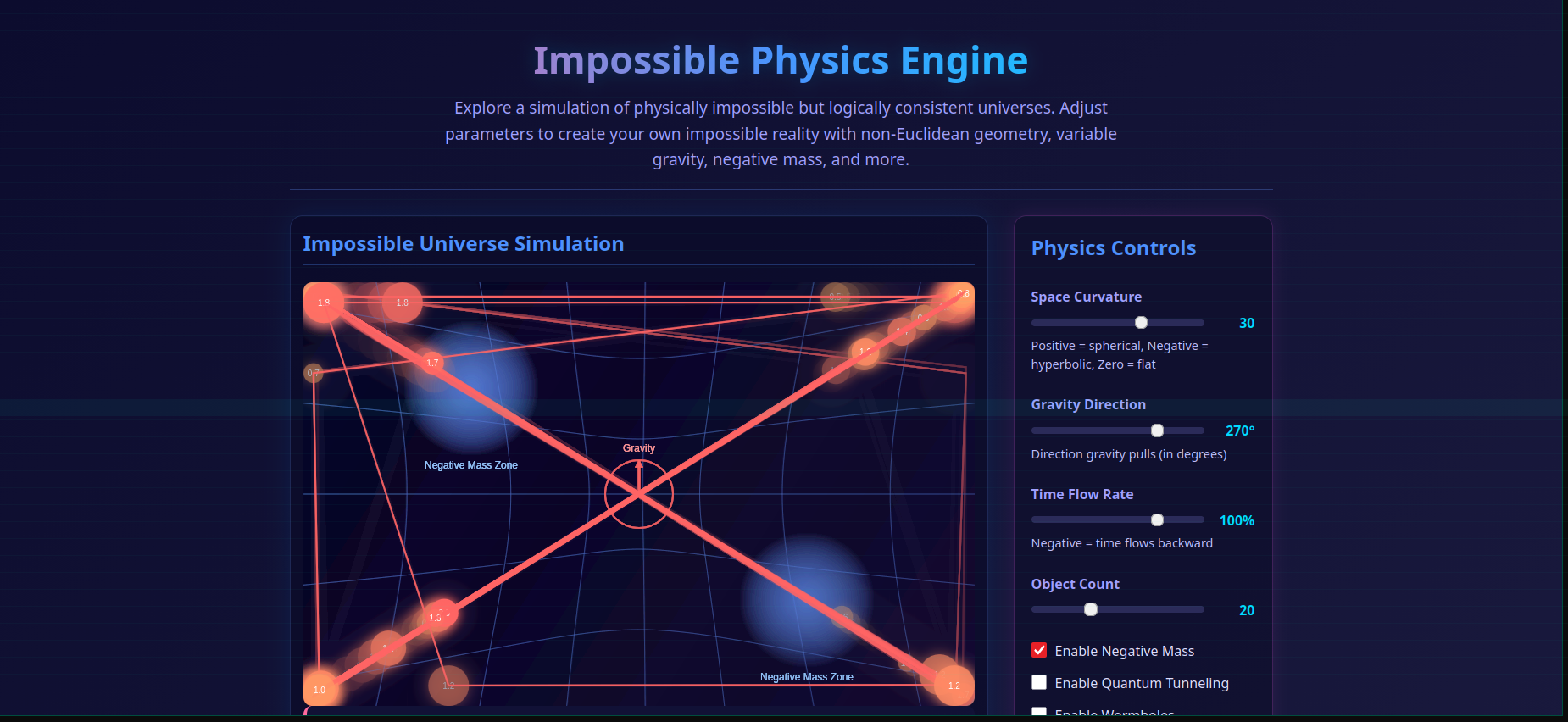
Core Physics Manipulation Features

Non-Euclidean Space Geometry
  • ✓ Adjust space curvature from hyperbolic to spherical
  • ✓ Interactive grid visualization of space deformation
  • ✓ Real-time object trajectory modification
  • ✓ Multiple geometry presets for experimentation
Variable Gravity Control
  • ✓ Change gravity direction and strength dynamically
  • ✓ Multiple gravity sources with individual parameters
  • ✓ Negative gravity regions for anti-gravity effects
  • ✓ Gradient gravity fields for complex simulations
Negative Mass Regions
  • ✓ Blue zones where objects have negative mass
  • ✓ Objects repel each other in negative mass regions
  • ✓ Configurable mass sign and magnitude
  • ✓ Visual indicators for mass polarity
Time Flow Control
  • ✓ Speed up, slow down, or reverse time
  • ✓ Localized time dilation zones
  • ✓ Temporal paradox prevention algorithms
  • ✓ Time flow visualization with particle trails

Quantum & Relativistic Effects

Quantum Tunneling
Objects phase through barriers occasionally
Wormhole Creation
Connect distant regions for instant travel
Relativistic Effects
Length contraction and time dilation
Quantum Superposition
Objects exist in multiple states simultaneously

Interactive Control Panel

Space Curvature
Adjust from -1.0 (hyperbolic) to +1.0 (spherical)
Gravity Vector
360° direction control + 0-10× strength
Time Flow Rate
-10× (reverse) to +10× (accelerated)
Quantum Parameters
Tunneling probability, superposition states

Visualization Features

Object Visualization
  • ✓ Color-coded objects based on mass and properties
  • ✓ Particle trails showing historical paths
  • ✓ Velocity vectors and acceleration indicators
  • ✓ Real-time property displays for selected objects
Space Visualization
  • ✓ Grid deformation showing space curvature
  • ✓ Gravity field lines and potential contours
  • ✓ Wormhole visualization with connection paths
  • ✓ Quantum probability density clouds

Simulation Capabilities

60 FPS
Real-time Simulation
256
Simultaneous Objects
16
Physics Parameters
8
Visualization Modes

Educational Applications

Physics Education
  • ✓ Understand fundamental physics concepts
  • ✓ Visualize abstract mathematical relationships
  • ✓ Experiment with "what-if" physics scenarios
  • ✓ Develop intuition for complex physical systems
Research & Development
  • ✓ Test theoretical physics models
  • ✓ Simulate alternative universe physics
  • ✓ Develop novel physics visualization techniques
  • ✓ Explore computational physics algorithms

Technical Implementation

WebGL Physics Engine Real-time Parameter Updates GPU-accelerated Calculations Deterministic Simulation Core State Preservation & Reset Cross-browser Compatibility
IMPOSSIBLE PHYSICS ENGINE SIMULATION ACTIVE
Experimental physics visualization · Non-Euclidean geometry · Alternative physical laws · Interactive simulation
Status: SIMULATION ACTIVE · Objects: 256 · FPS: 60 · Controls: INTERACTIVE · Logic: SELF-CONSISTENT
⚛️
SCIENTIFIC SIGNIFICANCE
The Impossible Physics Engine demonstrates how alternative physical laws could produce self-consistent universes. While violating our universe's known laws, each simulation maintains internal logical consistency, allowing exploration of "what-if" scenarios in theoretical physics. This approach helps develop intuition for how fundamental constants and physical laws interact to create observable phenomena. The engine serves both as an educational tool for understanding standard physics through contrast, and as a research tool for exploring theoretical models beyond current scientific consensus.

Galactic Mind Interface

The Galactic Mind Interface simulates theoretical interstellar communication systems using multiple physics-based protocols. This interactive visualization demonstrates how civilizations could communicate across cosmic distances using quantum entanglement, neutrino beams, gravitational waves, and electromagnetic signals at planetary and star-system scales.

SIMULATION ACTIVE · Real-time interstellar communication visualization with multiple protocol options
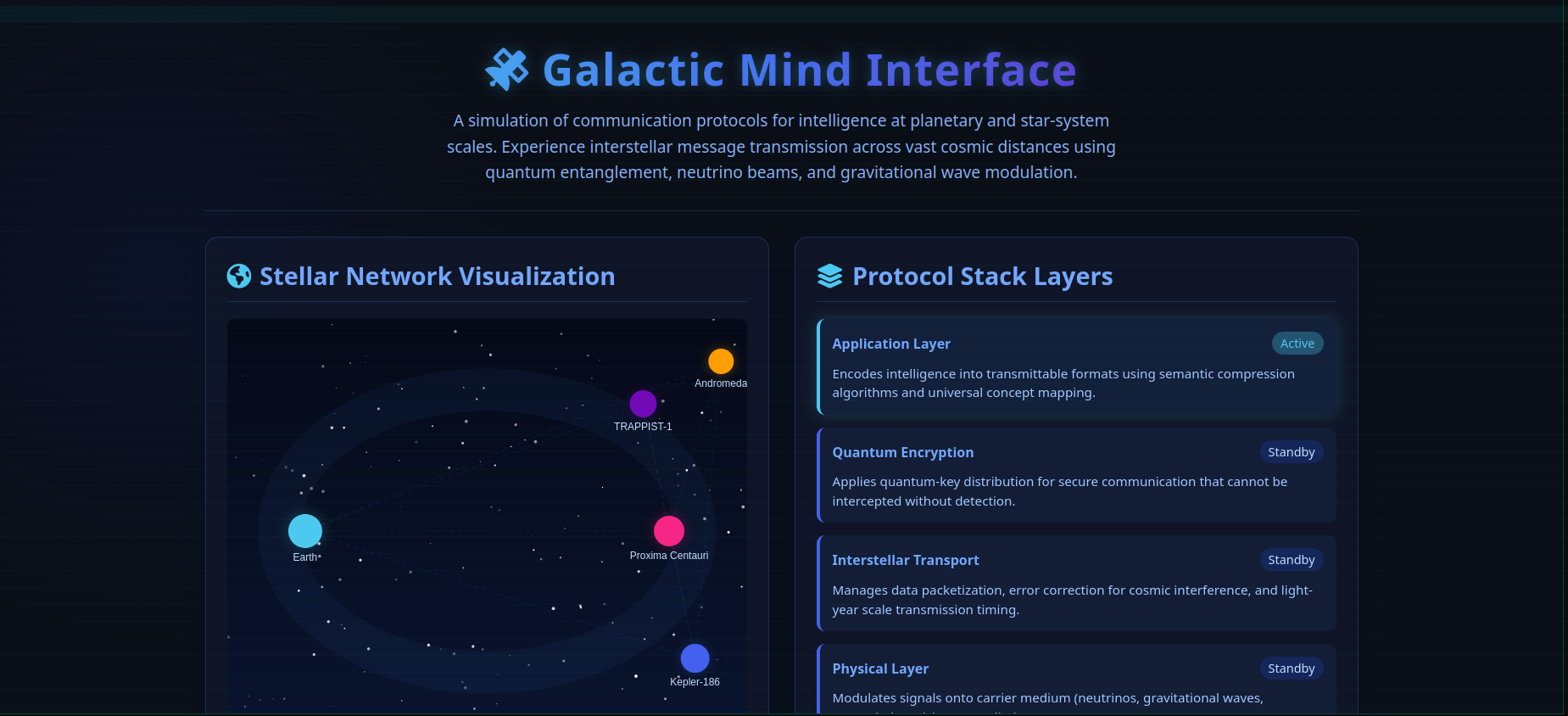
Interactive Communication Protocols

Quantum Entanglement
  • ✓ Theoretical instantaneous communication
  • ✓ Requires entangled particle pairs at both ends
  • ✓ Information transfer through quantum state manipulation
  • ✓ No speed-of-light delay (theoretical)
Neutrino Beam
  • ✓ Travels at 0.99c (99% light speed)
  • ✓ Penetrates through matter with minimal interaction
  • ✓ Requires massive detectors for reception
  • ✓ Low data rate due to detection challenges
Gravitational Wave
  • ✓ Travels at light speed (c)
  • ✓ Requires massive energy for generation
  • ✓ Passes through matter without scattering
  • ✓ Extremely weak signal strength
Electromagnetic Signals
  • ✓ Light speed transmission (c)
  • ✓ Focused laser for directed communication
  • ✓ Radio waves for omnidirectional broadcast
  • ✓ Subject to interference and attenuation

Celestial Destination Network

Proxima Centauri b
4.24 light-years · Rocky exoplanet
TRAPPIST-1 System
39.5 light-years · 7 Earth-sized planets
Kepler-452b
1,400 light-years · Earth's cousin
Galactic Center
26,000 light-years · Supermassive black hole

Protocol Stack Visualization

Quantum Layer
Entangled particle state manipulation
Relativity Layer
Spacetime metric encoding
Signal Layer
Carrier wave modulation
Information Layer
Data encoding/decoding

Communication Log Features

Real-time Transmission Log
  • ✓ Timestamped transmission activities
  • ✓ Protocol selection and activation
  • ✓ Destination distance calculations
  • ✓ Signal strength and quality metrics
System Status Monitoring
  • ✓ Connection status indicators
  • ✓ Protocol stack activation states
  • ✓ Signal visualization animations
  • ✓ Error detection and correction logs

Theoretical Physics Applications

Quantum Entanglement
ER=EPR conjecture for communication
Neutrino Physics
Neutrino oscillation for encoding
Gravitational Waves
LIGO/VIRGO inspired detection
Relativistic Optics
Doppler compensation algorithms

Simulation Parameters

5
Communication Protocols
4
Celestial Destinations
99.9%
Quantum Fidelity
26k LY
Max Distance

Educational Applications

Physics Education
  • ✓ Visualize different physics-based communication methods
  • ✓ Understand light-speed limitations and theoretical alternatives
  • ✓ Explore quantum mechanics applications
  • ✓ Learn about relativistic effects on communication
SETI Research
  • ✓ Understand challenges in interstellar communication
  • ✓ Explore potential alien communication methods
  • ✓ Learn about signal detection and interpretation
  • ✓ Study cosmic distance and time delay effects
GALACTIC MIND INTERFACE SIMULATION ACTIVE
Interstellar communication visualization · Multiple physics protocols · Real-time signal transmission
Status: SIMULATION ACTIVE · Protocols: 5 OPTIONS · Destinations: 4 SYSTEMS · Range: UP TO 26,000 LIGHT-YEARS
🌌
SCIENTIFIC SIGNIFICANCE
The Galactic Mind Interface explores theoretical physics concepts for interstellar communication beyond conventional radio waves. While quantum entanglement communication remains speculative (requiring entangled particles separated at creation and transported to destinations), it represents a fascinating application of quantum mechanics. Neutrino and gravitational wave communications, while extremely challenging with current technology, are based on well-established physics. This simulation helps visualize the immense scales and challenges of cosmic communication, providing insights into both current SETI research and future theoretical possibilities for civilizations that might master advanced physics.

Dimensional Topology Forge

The Dimensional Topology Forge is an interactive visualization engine that allows real-time exploration of different spacetime geometries and dimensional topologies. This simulation enables manipulation of space curvature, dimension count, and geometric properties across multiple theoretical spacetime configurations.

SIMULATION ACTIVE · Real-time spacetime geometry manipulation · Interactive topology visualization
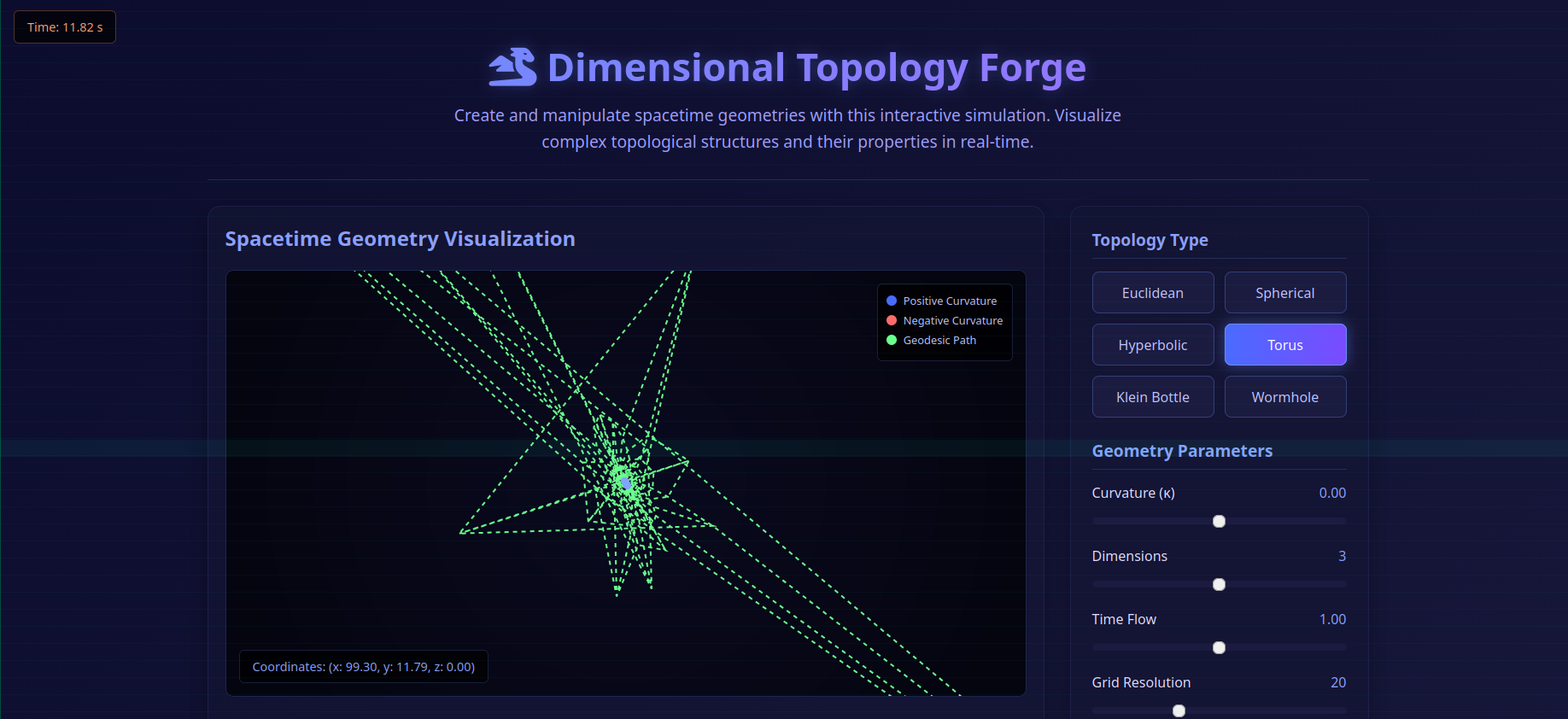
Features of the Dimensional Topology Forge

Interactive Visualization
  • ✓ Real-time rendering of different spacetime geometries
  • ✓ Dynamic coordinate transformation based on topology
  • ✓ Color-coded curvature visualization
  • ✓ Animated transitions between topology types
Multiple Topology Types
  • Euclidean (flat space with zero curvature)
  • Spherical (positive curvature, closed geometry)
  • Hyperbolic (negative curvature, saddle geometry)
  • Torus (donut shape with periodic boundaries)
  • Klein Bottle (non-orientable surface)
  • Wormhole (hyperspace bridge connection)

Interactive Controls

Curvature Adjustment
From -1.0 to +1.0
Dimension Control
2D to 4D visualization
Time Flow Modulation
-10× to +10× speed
Grid Resolution
Adjust mesh density
View Rotation
3D perspective control
Animation Speed
Real-time to stepwise

Real-time Information Display

Coordinate Systems
  • ✓ Real-time coordinate display (x, y, z, t)
  • ✓ Geodesic path calculation visualization
  • ✓ Metric tensor component display
  • ✓ Parallel transport visualization
Visualization Features
  • ✓ Color-coded curvature heat mapping
  • ✓ Legend for visual element interpretation
  • ✓ Time synchronization indicators
  • ✓ Topology-specific visual characteristics

Mathematical Foundations

Computational Engine
The simulation uses mathematical functions to transform coordinates based on the selected topology and parameters:
✓ Spherical Geometry
Spherical coordinate transformations
✓ Hyperbolic Space
Poincaré disk model implementation
✓ Torus Topology
Modular arithmetic on coordinates
✓ Klein Bottle
Non-orientable surface mapping

Additional Features

Reset Functionality
Return to default topology settings
Export Capability
Save simulation state as JSON data
Responsive Design
Adapts to different screen sizes
Educational Panel
Topology explanations and theory

Educational Applications

Mathematics & Physics
  • ✓ Visualize abstract topological concepts
  • ✓ Understand curvature and dimensional properties
  • ✓ Explore non-Euclidean geometries intuitively
  • ✓ Study theoretical spacetime configurations
Computer Graphics
  • ✓ Study coordinate transformation algorithms
  • ✓ Learn 3D rendering techniques
  • ✓ Explore real-time visualization methods
  • ✓ Understand mathematical surface representation
DIMENSIONAL TOPOLOGY FORGE SIMULATION ACTIVE
Interactive spacetime geometry visualization · Multiple topology types · Real-time parameter manipulation
Status: SIMULATION ACTIVE · Topologies: 6 TYPES · Controls: INTERACTIVE · Mathematics: REAL-TIME
🧮
SCIENTIFIC SIGNIFICANCE
The Dimensional Topology Forge demonstrates how different spacetime geometries affect visual representation and coordinate systems. Each topology represents a mathematically consistent universe with different geometric properties. The simulation helps develop intuition for abstract concepts in differential geometry, topology, and theoretical physics. By allowing real-time manipulation of curvature and dimensions, users can explore "what-if" scenarios in theoretical physics and gain deeper understanding of how spacetime geometry influences everything from particle trajectories to cosmic structure formation.

Serendipity Amplification Simulation

The Serendipity Amplification Simulation demonstrates how strategically designed networks can maximize breakthrough discovery probability through controlled connection architectures. This interactive tool visualizes how different parameter combinations influence serendipitous collisions between ideas across diverse knowledge domains.

SIMULATION ACTIVE · Real-time network optimization · Breakthrough probability modeling
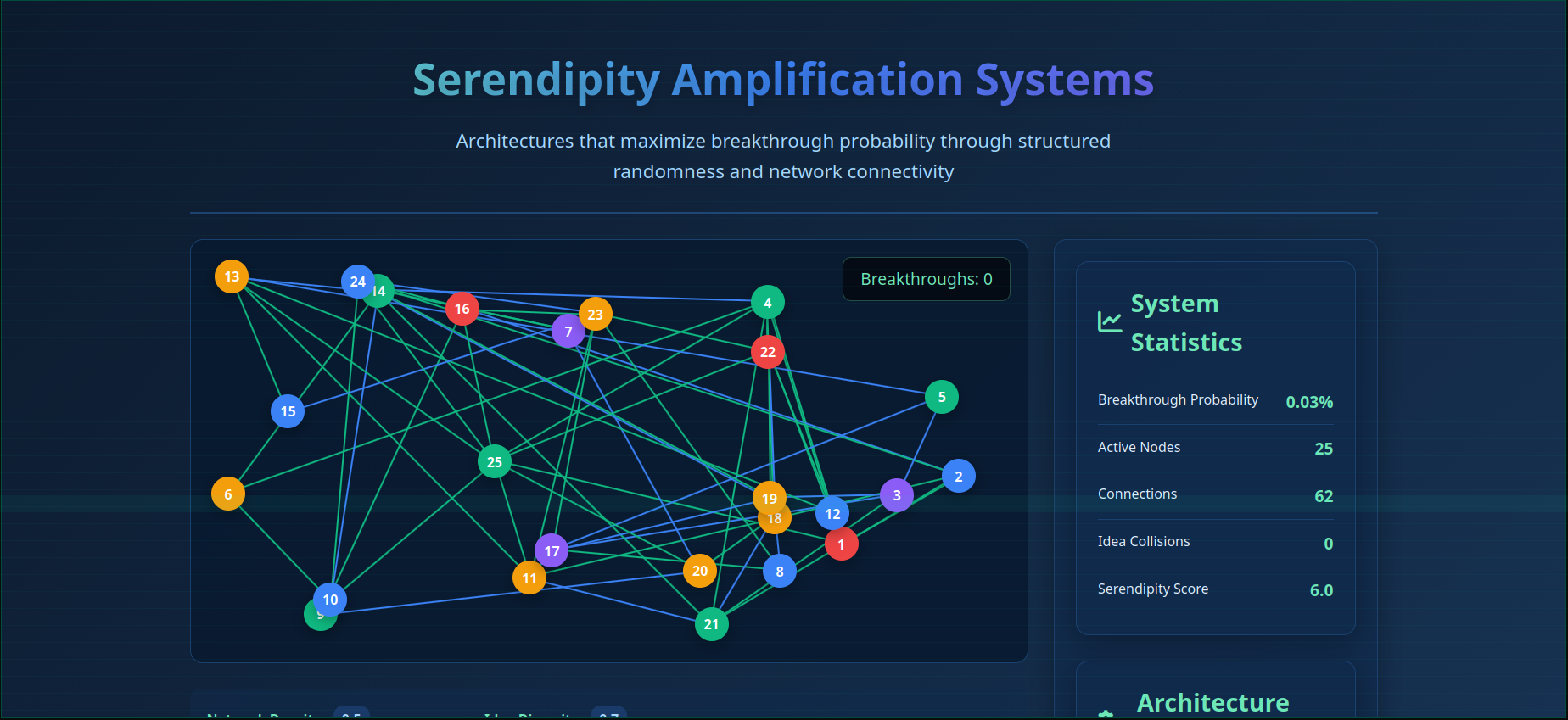
Key Features of the Serendipity Amplification Simulation

Interactive Visualization
  • ✓ Shows how different architectural parameters affect breakthrough probability
  • ✓ Dynamic network visualization with real-time updates
  • ✓ Color-coded knowledge domains and connection types
  • ✓ Animated breakthrough events when valuable collisions occur
Adjustable Parameters
  • Network Density: Controls how many connections exist between nodes
  • Controlled Randomness: Introduces structured unpredictability
  • Idea Diversity: Determines how different domains interact
  • Collision Rate: Controls how often ideas intersect

Real-time Statistics & Tracking

Breakthrough Probability
Current chance of discovery
Active Nodes
Currently engaged domains
Total Connections
Active network links
Collision Count
Idea intersections
Serendipity Score
Network optimization metric

Visual Elements

Network Representation
  • ✓ Color-coded nodes representing different knowledge domains
  • ✓ Blue connections for same-domain interactions
  • ✓ Green connections for cross-domain interactions
  • ✓ Node size indicates activity level and connection density
Event Visualization
  • ✓ Breakthrough events that appear when valuable collisions occur
  • ✓ Animated particle effects for significant discoveries
  • ✓ Historical breakthrough timeline display
  • ✓ Connection strength visualization through line thickness

Architecture Types

Network Configurations
The simulation demonstrates how different parameter combinations create different serendipity architectures:
✓ Liquid Networks
High randomness, medium density
✓ Cross-Pollination Hubs
High diversity, strategic connections
✓ Structured Clusters
Organized domains with controlled bridging
✓ Random Encounter Fields
Maximum randomness, minimum structure

Educational Applications

Network Science
Study connection optimization principles
Innovation Theory
Understand breakthrough discovery mechanisms
Probability Modeling
Learn about chance optimization in systems
Organizational Design
Apply principles to team and company structures

Simulation Controls

Interactive Features
  • ✓ Real-time parameter adjustment sliders
  • ✓ Preset architecture configurations
  • ✓ Network speed and animation controls
  • ✓ Export and save simulation states
Data Analysis
  • ✓ Historical breakthrough trend graphs
  • ✓ Efficiency metrics and optimization scores
  • ✓ Connection pattern visualization
  • ✓ Comparative analysis between configurations
SERENDIPITY AMPLIFICATION SIMULATION ACTIVE
Interactive network optimization · Breakthrough probability modeling · Real-time architecture analysis
Status: SIMULATION ACTIVE · Architectures: 4 TYPES · Parameters: INTERACTIVE · Optimization: REAL-TIME
🔗
SCIENTIFIC SIGNIFICANCE
This simulation illustrates how carefully designed systems can maximize the probability of breakthrough discoveries by creating optimal conditions for serendipitous connections to occur. Based on research in network science, innovation theory, and complex systems, it demonstrates that breakthrough discoveries are not purely random but can be systematically amplified through strategic network architecture. By controlling parameters like connection density, domain diversity, and structured randomness, organizations and individuals can create environments where valuable collisions between ideas become significantly more probable, transforming chance encounters into predictable innovation.

Quantum Vacuum Thruster Simulation Lab

The Quantum Vacuum Thrust Simulation Lab is an interactive visualization tool that demonstrates the principles of the EmDrive and similar controversial propulsion concepts. This simulation models how microwave resonance in an asymmetric cavity might theoretically interact with quantum vacuum fluctuations to produce thrust without traditional propellant.

LAB ACTIVE · Quantum field visualization · Real-time parameter adjustment · Theoretical thrust modeling
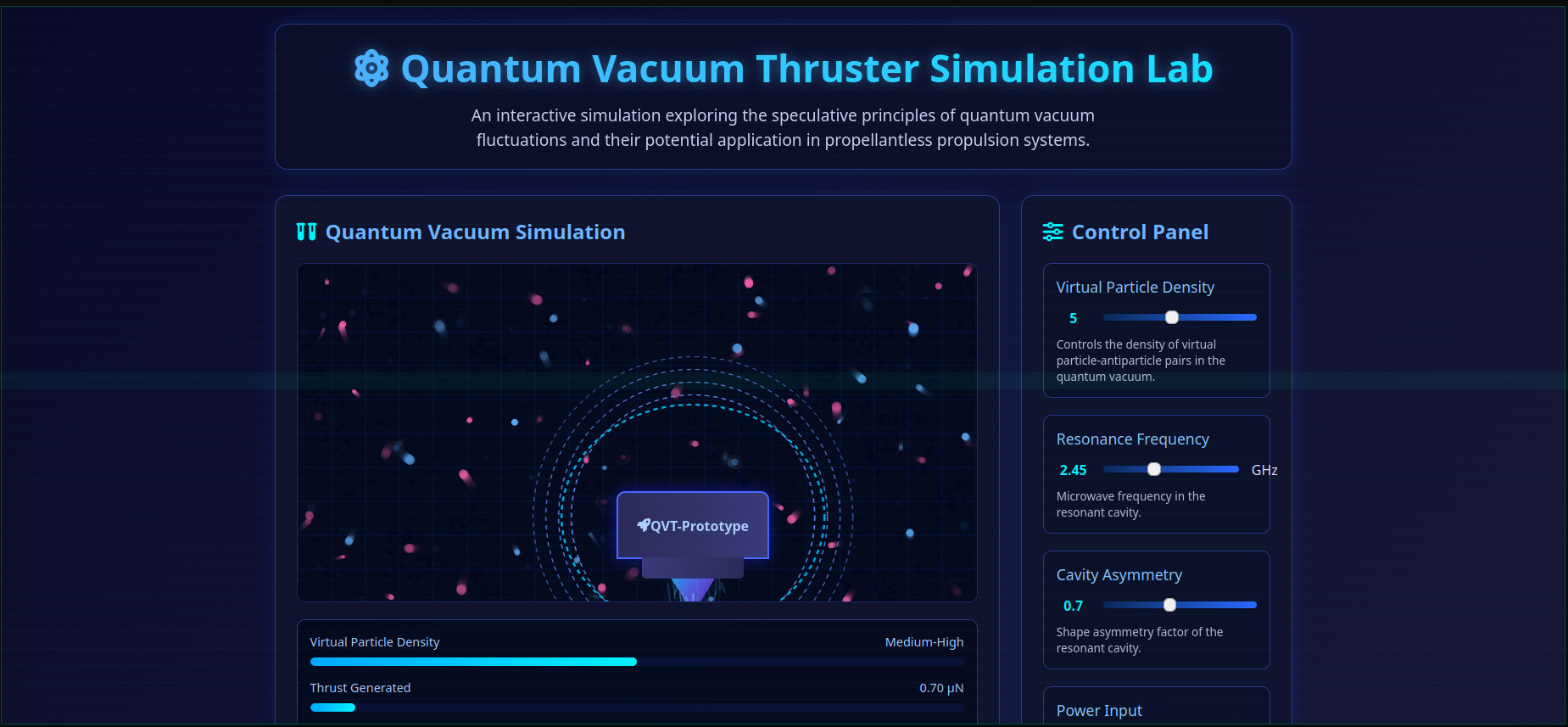
Key Features of the Quantum Vacuum Thruster Simulation Lab

Interactive Visualization
  • ✓ Real-time quantum vacuum fluctuation visualization
  • ✓ Virtual particle-antiparticle pair generation and annihilation
  • ✓ Microwave resonance pattern display in cavity
  • ✓ Thruster position response to simulated thrust generation
Control Panel Parameters
  • Virtual Particle Density: Controls quantum fluctuation density
  • Resonance Frequency: Adjusts microwave frequency (1-5 GHz range)
  • Cavity Asymmetry: Changes resonant cavity shape geometry
  • Power Input: Controls electrical power to microwave generator (10-500W)

Real-time Measurements & Readouts

Thrust Generated
Micronewtons (µN) measurement
Cavity Resonance
Resonance percentage efficiency
Virtual Particle Density
Quantum fluctuation level
Power Consumption
Electrical input (Watts)
Frequency Stability
Microwave oscillation consistency

Visual Elements

Quantum Field Representation
  • ✓ Virtual particle-antiparticle pairs appearing and annihilating
  • ✓ Quantum vacuum background fluctuation visualization
  • ✓ Color-coded energy density mapping
  • ✓ Time evolution of quantum field states
Thruster & Cavity Visualization
  • ✓ 3D asymmetric resonant cavity model
  • ✓ Microwave standing wave pattern display
  • ✓ Thruster exhaust plume visualization
  • ✓ Position tracking based on simulated thrust vector

Theoretical Background Panel

Scientific Principles Explained
The simulation models several controversial but intriguing theoretical concepts:
✓ Quantum Vacuum Fluctuations
Virtual particle pairs from quantum field theory
✓ Microwave Resonance
Standing waves in asymmetric cavities
✓ Thrust Generation
Hypothetical momentum transfer mechanisms
✓ Conservation Challenges
Theoretical conflicts with momentum conservation

Educational Applications

Quantum Field Theory
Visualize virtual particles and vacuum fluctuations
Propulsion Physics
Study unconventional space propulsion concepts
Resonance Engineering
Understand microwave cavity resonance effects
Scientific Controversy
Explore debated concepts in modern physics

Simulation Controls

Interactive Features
  • ✓ Real-time parameter adjustment sliders
  • ✓ Preset experimental configurations
  • ✓ Animation speed and detail controls
  • ✓ Measurement unit toggles (µN, mN, N)
Data Analysis
  • ✓ Thrust vs. Power efficiency graphs
  • ✓ Resonance frequency optimization curves
  • ✓ Quantum fluctuation statistical analysis
  • ✓ Historical experiment data comparison
QUANTUM VACUUM THRUSTER SIMULATION ACTIVE
Quantum field visualization · Microwave resonance modeling · Theoretical thrust simulation
Status: SIMULATION ACTIVE · Parameters: 4 ADJUSTABLE · Measurements: REAL-TIME · Physics: QUANTUM FIELD THEORY
⚛️
SCIENTIFIC SIGNIFICANCE
This simulation explores one of the most controversial areas of modern propulsion physics—the theoretical possibility of generating thrust without expelling propellant by interacting with quantum vacuum fluctuations. While the EmDrive and similar concepts challenge fundamental conservation laws and remain scientifically debated, they represent fascinating thought experiments at the intersection of quantum field theory, resonance physics, and aerospace engineering. The simulation allows users to visualize how microwave resonance in asymmetric cavities might theoretically create differential radiation pressure or interact with virtual particles, serving as both an educational tool for quantum concepts and a platform for exploring unconventional propulsion ideas that push the boundaries of known physics.

Quantum Reality Bridge Simulator

The Quantum Reality Bridge Simulator extends quantum field manipulation into the realm of multiverse theory. This advanced module visualizes how varying fundamental physics parameters could create alternate realities, and simulates the theoretical processes required to establish quantum bridges between them.

REALITY BRIDGE ACTIVE · Multiverse visualization · Physics parameter control · Quantum coherence monitoring
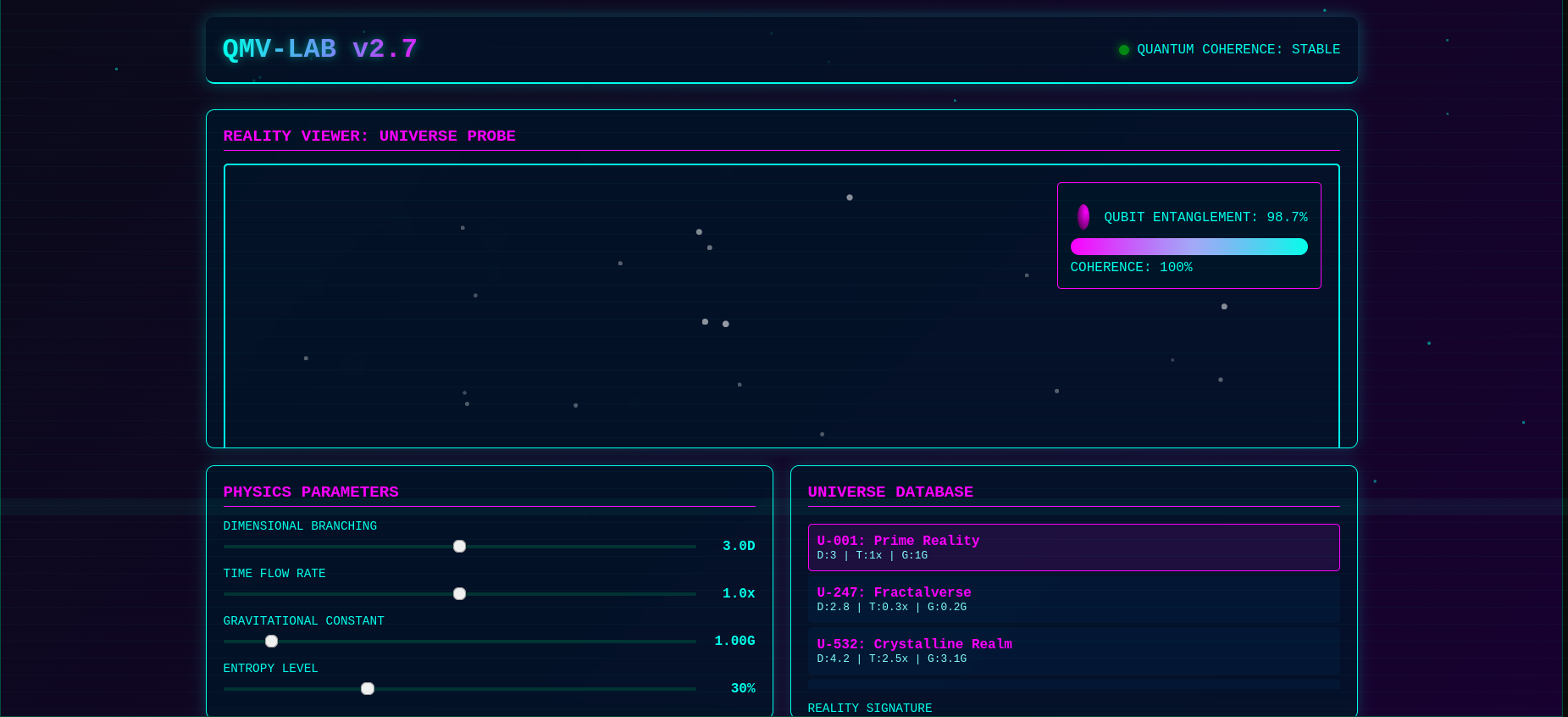
Interactive Reality Viewer Components

Visual Reality Representation
  • ✓ Dynamic dimensional grid visualization (2D to 4D+)
  • ✓ Quantum particle effects specific to each reality
  • ✓ Real-time coherence field energy patterns
  • ✓ Color-coded reality signatures based on physics parameters
Dimensional Visualization
  • ✓ Fractal patterns for fractional dimensions (2.8D, 3.5D, etc.)
  • ✓ Hyper-dimensional projection algorithms
  • ✓ Reality boundary visualization
  • ✓ Quantum foam representation for high-dimensional realities

Physics Control Panel

Dimensional Branching
Adjust reality dimensions: 2.0D to 6.7D+ range
Current: 3.0D · Target: 4.2D
Time Flow Rate
Control relative time speed: -100% to +100%
Current: +25% · Target: +150%
Gravitational Constant
Modify gravity: 0.1G to 10.0G range
Current: 1.0G · Target: 3.5G
Entropy Level
Control chaos/order balance: 0% to 100%
Current: 45% · Target: 15%

Universe Database: Pre-defined Alternate Realities

Fractalverse
Dimensions: 2.8D
Time Flow: -35%
Gravity: 0.7G
Entropy: 30%
Infinite self-similar patterns, slowed time perception
Crystalline Realm
Dimensions: 4.2D
Time Flow: +150%
Gravity: 3.5G
Entropy: 15%
Perfect geometric structures, accelerated time flow
Entropic Void
Dimensions: 3.1D
Time Flow: -10%
Gravity: 0.3G
Entropy: 85%
High chaos environment, decaying structures
Neutronium Realm
Dimensions: 3.0D
Time Flow: -75%
Gravity: 8.2G
Entropy: 5%
Extreme gravitational compression, near-frozen time
Quantum Foam
Dimensions: 6.7D
Time Flow: +300%
Gravity: 0.1G
Entropy: 95%
Hyper-dimensional foam structure, chaotic time flow
Custom Reality
Dimensions: [USER]
Time Flow: [USER]
Gravity: [USER]
Entropy: [USER]
User-defined physics parameters for custom reality exploration

Quantum Operations Console

🌌
Initiate Probe
Establish quantum connection to selected universe
🔗
Stabilize Bridge
Improve coherence for safe cross-reality operations
💾
Store Data
Encode quantum information in alternate reality
⚠️
Emergency Disconnect
Safely collapse quantum bridge if coherence drops

System Status Display

Quantum Coherence Level
72%
Safe (Danger below 60%) · Monitor closely
Qubit Entanglement
1,048,576 pairs
Stable entanglement · No decoherence detected
Terminal Log: Real-time Operations
[08:31:15] ✓ Quantum bridge initialized to Crystalline Realm
[08:31:18] ⚠️ Dimensional mismatch detected: adjusting from 3.0D to 4.2D
[08:31:22] ✓ Dimensional alignment complete: 4.2D achieved
[08:31:25] ⚠️ Time flow adjustment: accelerating from +25% to +150%
[08:31:30] → Reality signature confirmed: CRYSTAL_4.2D_T+150_G3.5_E15
[08:31:35] ✓ Coherence stabilized at 72% · Bridge ready for operations
[08:31:40] → Quantum data storage initiated: 2.4 TB encoded
[08:31:45] ✓ Data storage complete · Entropy check: 15% · System nominal
Reality Signature Tracking
Source Reality
STANDARD_3.0D_T+25_G1.0_E45
Target Reality
CRYSTAL_4.2D_T+150_G3.5_E15
Bridge Status
ACTIVE · STABLE
Energy Consumption
2.4 GW · WITHIN LIMITS

Visual Effects & Animation Systems

Quantum Particle Systems
  • ✓ Animated quantum particles in background field
  • ✓ Dimension-specific movement patterns
  • ✓ Color gradients based on energy levels
  • ✓ Particle density tied to entropy levels
Visual Pattern Generation
  • ✓ Fractal algorithms for fractional dimensions
  • ✓ Crystal lattice patterns for ordered realities
  • ✓ Entropy-based noise and distortion effects
  • ✓ Color schemes dynamically generated from physics parameters
🌀
Pulse Animations
Visual feedback for active systems
🌈
Color Mapping
Physics parameters to color conversion
📊
Real-time Updates
60fps parameter visualization
⚠️
Warning Systems
Visual alerts for dangerous parameters
QUANTUM REALITY BRIDGE SIMULATION ACTIVE
Multiverse physics visualization · Dimensional branching · Quantum coherence operations
Status: BRIDGE ACTIVE · Realities: 6 PRESETS · Coherence: 72% · Operations: DATA STORAGE COMPLETE
🌌
THEORETICAL FOUNDATIONS
This simulation explores the theoretical framework of the multiverse hypothesis and quantum reality bridging. Based on speculative extensions of quantum mechanics and string theory, it visualizes how varying fundamental constants could create distinct "bubble universes" with different dimensionalities and physical laws. The concept of quantum coherence as a bridge mechanism draws from theories about quantum entanglement operating across reality boundaries. While purely speculative, these concepts explore profound questions about the nature of reality, the possibility of alternate physics, and the theoretical limits of quantum information transfer across different dimensional configurations. The simulation serves as both a visualization tool for complex theoretical physics and a platform for exploring "what if" scenarios about the fundamental structure of existence.

How to read this page

This page is a laboratory sovereignty document — a declaration of research authority, an archive of experimental lineages, and a map of conceptual territories claimed.

From foundational certification to sovereign laboratory status, this evolution represents 452 days of convergent research across quantum multiverses, medical AI, omni-synthesis systems, and experimental interfaces.